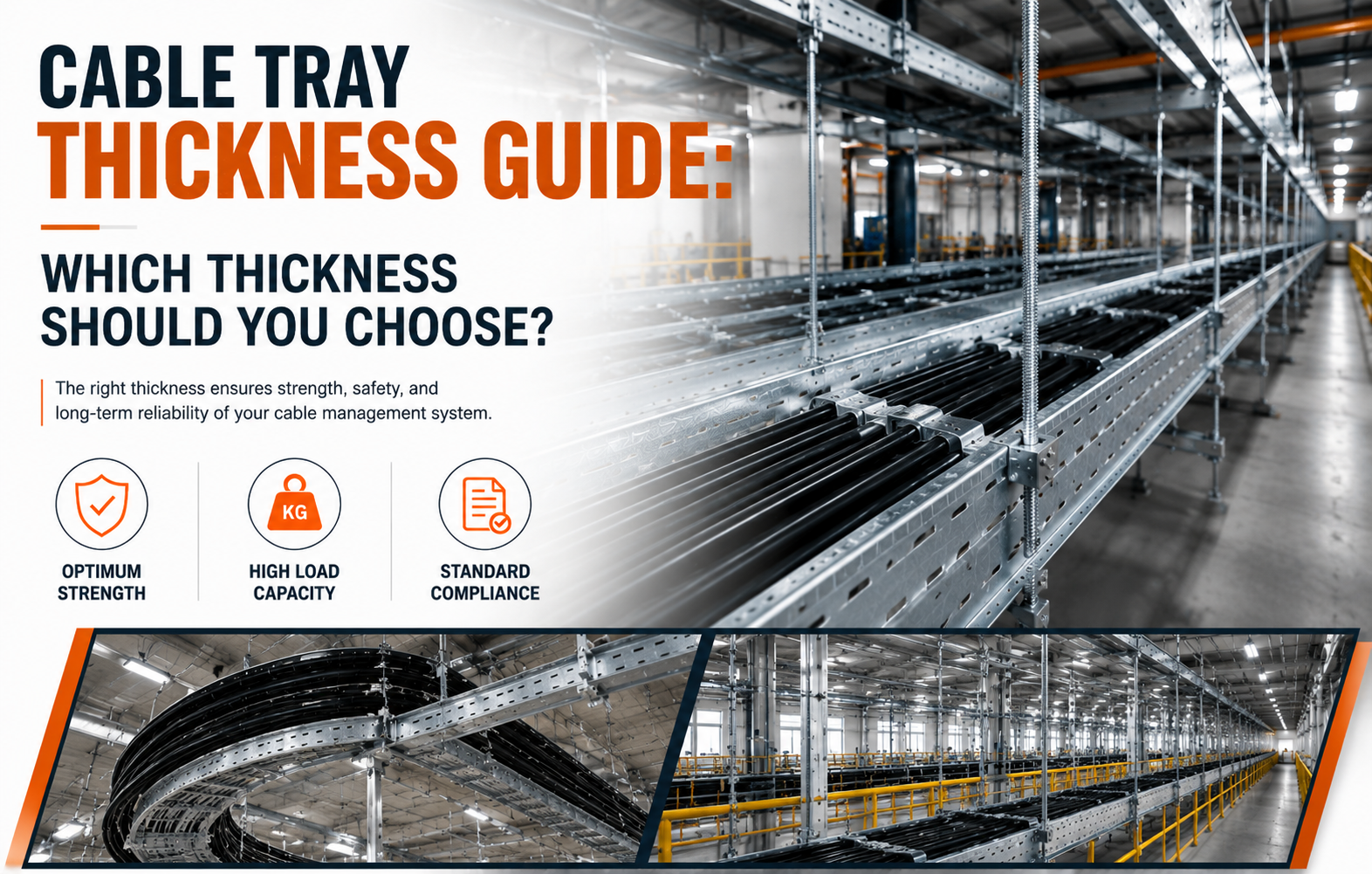
Cable Tray Thickness Guide: Which Thickness Should You Choose?
04 Jul 2026 || By: Admin
The Core Importance of Sheet Metal Gauge Selection
Sizing an industrial electrical containment network involves precise mechanical engineering that goes far beyond determining spatial paths. Choosing the right material gauge and sheet thickness is a foundational step during structural engineering design. If a layout uses an under-specced material, it will face permanent structural sagging or catastrophic buckling over time. Conversely, choosing an excessively heavy sheet gauge increases material procurement costs and places unnecessary dead-load strain on support brackets. For major manufacturing hubs, commercial infrastructure, and high-voltage distribution facilities from Mumbai to major production grids in Dubai and the UAE, choosing the right cable tray thickness ensures maximum safety and structural longevity.
1. Reference Cable Tray Thickness Chart & Structural Classifications
Cable support products are engineered using precise sheet steel thicknesses chosen around distinct physical load classifications. The required gauge scales based on the cumulative cable weight and the physical distance between consecutive hangers. Below is a foundational overview highlighting standard parameters:
| Material Thickness (mm) | Common Industry Sheet Gauge | Standard Cable Tray Profiles | Primary Working Environments |
|---|---|---|---|
| 1.2mm – 1.5mm | 18 Gauge to 16 Gauge | Light Perforated Trays, Wire Mesh Systems, Small Raceways | Indoor climate-controlled commercial zones, server rooms, automated control panels, and light instrumentation networks. |
| 1.6mm – 2.0mm | 14 Gauge to 12 Gauge | Standard Perforated, Light-to-Medium Ladder Systems | High-rise commercial properties, manufacturing facilities, processing spaces, and medium-scale industrial substations. |
| 2.5mm – 3.0mm | 11 Gauge to 10 Gauge | Heavy-Duty Welded Ladder Trays, High-Tensile Channels | Heavy industrial plants, sub-station grids, thermal power facilities, marine infrastructures, and wide-span utility frameworks. |
2. Selecting Material Gauges Based on System Styles
Different system styles utilize specialized structural sheets to deliver optimal support performance:
- Ladder Cable Tray Thickness: High-capacity ladder systems carry dense bundles of heavy power cables over long spans. To prevent linear twisting, side-rail deflection, or rung deformation under dynamic load stresses, a heavy-duty ladder cable tray thickness between 2.0mm and 3.0mm is strongly recommended. This thick sheet metal layout ensures optimal structural rigidity and long-term system stability.
- Perforated Cable Tray Thickness: Perforated designs strike an ideal balance between low physical material weights and structural strength. They typically utilize gauges ranging from 1.2mm to 2.0mm, ensuring high cross-sectional stability across standard routing setups.
- Solid Bottom Trunking & Raceways: Often selected to achieve maximum electromagnetic shielding and complete environmental isolation for sensitive signal lines, closed raceway channels typically use 1.5mm to 2.0mm steel sheets to preserve flat tracking profiles across intermediate support mounts.
3. Critical Design Variables: Load Densities vs. Support Spacing
Determining the correct GI cable tray thickness depends on two core elements: the total cable structural weight density and the distance spanning your vertical support brackets. As support gaps expand from 1.5 meters up to wide-span intervals of 3, 6, or 9 meters, the internal bending stresses increase dramatically. Increasing the structural thickness creates deeper side-rail profiles and higher cross-sectional rigidity, allowing systems to satisfy strict NEMA deflection criteria safely. Furthermore, projects in marine locations across Dubai, the UAE, or coastal industrial belts near Mumbai require specifying heavier material gauges to offset potential material thinning caused by environmental corrosion over extended operating cycles.
Why Hutaib Electricals is Your Premier Global Manufacturing Partner
Securing maximum structural safety margins requires sourcing industrial containment components produced to exacting tolerances. Serving as an elite, high-capacity cable tray manufacturer in Mumbai and a trusted industrial exporter catering to high-load infrastructure projects across Dubai and the wider UAE, Hutaib Electricals produces a premier selection of containment hardware. Our advanced fabrication lines process top-tier Hot-Dip Galvanized Iron (GI), robust stainless steel, and specialized corrosion-resistant alloys across complete thickness ranges from 1.2mm up to 3.0mm. We engineer structural rigidity into every component, ensuring your critical routing systems endure long operational lifespans with complete structural integrity.
Conclusion
Selecting the ideal cable tray thickness is a critical engineering decision that directly impacts the structural longevity of your electrical distribution networks. By analyzing your long-term cable loads, physical support spacing, and local environmental conditions, you can accurately identify the optimal material gauge. Sourcing your containment frameworks from trusted industry leaders like Hutaib Electricals ensures your critical infrastructure remains fundamentally sound, code-compliant, and secure throughout its operational life.
FAQ: