Cable Trays vs Conduits: Which Is the Right Choice for Industrial Applications?
21 May 2026 || By: Admin
Introduction
Modern industries depend heavily on efficient electrical infrastructure to maintain safety, productivity, and uninterrupted operations. Whether it is a manufacturing plant, warehouse, power station, data center, or commercial building, choosing the right cable management system plays a crucial role in ensuring long-term operational efficiency. Among the most commonly used solutions, cable trays and conduits remain the preferred choices for industrial electrical installations.
Both systems are designed to protect and organize electrical wiring, but they serve different purposes depending on the industrial environment and operational requirements. Understanding the differences between these systems helps businesses select the most suitable cable management solution for safe and reliable electrical installations.
Understanding Cable Tray Systems in Industrial Infrastructure
Cable tray systems are widely used in industrial facilities because they provide an organized and accessible method for supporting electrical cables. These systems are commonly manufactured using galvanized steel, aluminum, stainless steel, and powder-coated materials to ensure durability in demanding environments.
Popular industrial cable tray systems include:
- Ladder cable trays
- Perforated cable trays
- Wire mesh cable trays
- Raceway cable trays
One of the biggest advantages of cable trays is their ability to support large volumes of power and communication cables while maintaining proper airflow.
Perforated cable trays
improve ventilation and help reduce cable overheating, while ladder cable trays offer excellent load-bearing capacity for heavy industrial wiring systems.What Are Electrical Conduits and Where Are They Used?
Electrical Conduits
are enclosed piping systems designed to provide maximum protection for electrical wiring. These conduits are commonly manufactured using PVC, steel, aluminum, or flexible metallic materials depending on the application requirements.Conduit systems are widely used in:
- Hazardous industrial locations
- Underground cable installations
- Chemical processing plants
- Outdoor electrical systems
- Commercial and pharmaceutical facilities
Since conduits completely enclose electrical cables, they provide excellent protection against moisture, dust, chemicals, corrosion, and accidental mechanical damage. This makes them highly suitable for industries requiring strict electrical safety standards.
Installation Comparison Between Cable Trays and Conduits
Installation efficiency is one of the most important factors industries consider while selecting cable support systems. Cable tray installations are generally faster and more cost-effective compared to conduit systems because cables can be easily placed and organized within the open tray structure.
Major advantages of cable tray installation include:
- Faster project completion
- Reduced labor costs
- Easy cable routing
- Quick future upgrades
- Simple maintenance access
Conduit installation is more labor-intensive because each cable must be individually pulled through enclosed piping. Complex conduit layouts often require multiple fittings, bends, and connectors, increasing installation time and overall project costs.
Safety and Protection in Industrial Environments
Safety is a major consideration in
industrial electrical infrastructure
. Conduits provide superior protection against environmental hazards, making them ideal for harsh industrial environments. Their enclosed structure protects cables from external contaminants and accidental contact.Cable trays, however, offer excellent organization and accessibility for indoor industrial applications. Hot dip galvanized cable trays and stainless steel cable trays provide long-term durability and corrosion resistance while simplifying cable inspection and maintenance.
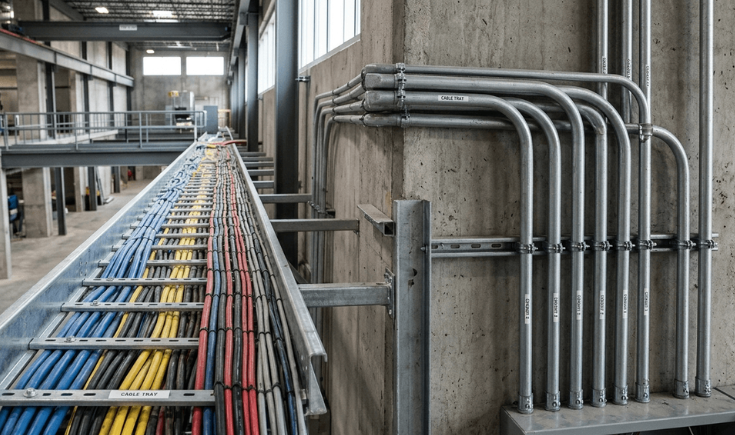
Many industries combine both systems to achieve maximum operational efficiency. For example, conduit systems may be installed in hazardous zones, while
ladder cable trays
manage large cable runs in production and utility areas.Cost Efficiency and Maintenance Benefits
Cable tray systems are generally more economical for large-scale industrial installations because they require fewer materials and lower labor costs. Their open structure also simplifies cable inspection, troubleshooting, and maintenance activities.
Conduit systems often involve higher installation costs due to additional materials and complex routing requirements. Maintenance can also become more challenging because enclosed cables are harder to access and replace.
For industries expecting future expansions or automation upgrades, cable trays offer better scalability and flexibility without major modifications to the existing infrastructure.
Which Is Better for Industrial Applications?
The choice between cable trays and conduits depends on the project environment, cable protection requirements, and operational goals. Cable trays are highly suitable for:
- Manufacturing plants
- Warehouses
- Commercial buildings
- Data centers
- Power distribution projects
Conduits are ideal for:
- Hazardous industrial areas
- Underground installations
- Chemical processing plants
- Outdoor electrical systems
- Moisture-prone environments
In many modern industrial projects, using both cable trays and conduits together provides the best balance between flexibility, organization, and cable protection.
Conclusion
As industrial infrastructure continues evolving, selecting the right electrical cable management system becomes increasingly important for workplace safety and operational efficiency. Cable trays provide flexibility, faster installation, easier maintenance, and cost savings, making them highly effective for most industrial cable routing applications.
Conduit systems offer enhanced protection in harsh or hazardous environments where electrical safety is critical. Businesses planning industrial electrical installations should carefully evaluate environmental conditions, project scale, maintenance needs, and future expansion requirements before choosing between cable trays and conduits.
Investing in the right cable support system helps industries achieve better electrical performance, improved safety standards, and long-term operational reliability.
FAQ: