How Corrosion Impacts Cable Tray Lifespan
21 Jun 2026 || By: Admin
The Silent Threat to Your Electrical Infrastructure
A sturdy cable management system is intended to function as the permanent structural backbone for industrial power and data routes. However, regardless of the initial build quality, environmental factors can dramatically reduce the efficiency and durability of this framework. Among all external threats, corrosion is the most aggressive and insidious. Understanding how corrosion attacks your infrastructure is the first step in extending the
cable tray lifespan
and maintaining peak operational safety.1. How Corrosion Physically Weakens Cable Trays
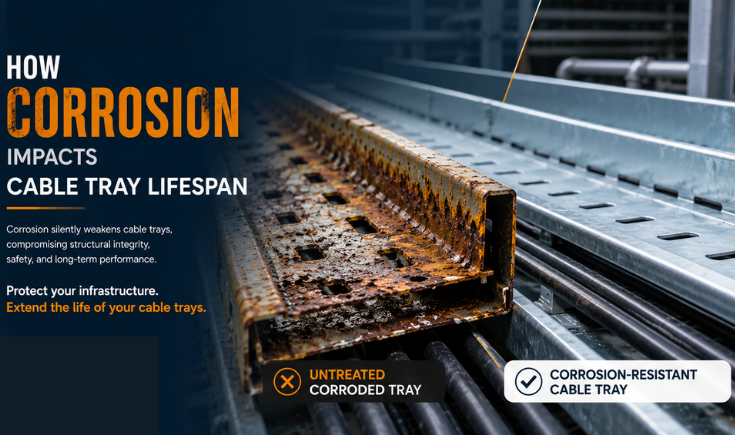
Corrosion is an electrochemical process where metals gradually degrade when exposed to moisture, airborne salts, or industrial chemicals. As rust begins to form, it literally eats away at the base metal. For a cable tray holding heavy bundles of industrial wiring, this means a steady reduction in tensile strength and load-bearing capacity. Over time, the tray's metal structure thins, leading to sagging, buckling, and ultimately, a catastrophic mechanical collapse under the weight of the cables.
2. The Safety and Operational Hazards
When a cable tray corrodes, the danger extends beyond just the tray itself. A compromised tray can develop sharp, jagged rusted edges that can slice through cable insulation during vibrations or thermal expansion. This exposes live wires, massively increasing the risk of short circuits, electrical fires, and extended facility downtime. By ignoring the effects of corrosion, facility managers inadvertently jeopardize both their personnel and their costly operational processes.
3. Combating Corrosion Through Material Selection
The most effective strategy to prolong the life of your installation is choosing the correct materials tailored to the environment.
- FRP / GRP Cable Trays: Fiber Reinforced Plastic is inherently non-metallic. It is completely immune to rust, making it the superior choice for highly corrosive zones like chemical plants, offshore platforms, or coastal facilities.
- Hot-Dip Galvanized Iron (GI): For general industrial use, dipping standard steel into molten zinc creates a thick, sacrificial protective layer that vastly outperforms standard pre-galvanized options in rust prevention.
- Stainless Steel: Utilizing high-grade alloys provides excellent natural resistance to pitting and surface rust in food-grade or highly sanitized environments.
Why Hutaib Electricals is the Trusted Solution
To secure a framework that stands the test of time, you need a partner equipped with deep technical expertise. As a leading manufacturer based in Pune, Hutaib Electricals specializes in delivering ultra-durable
GI and FRP cable trays
engineered to defy harsh environmental conditions. We prioritize precise manufacturing standards, ensuring that every batch delivers optimal rust resistance, high load capacities, and extensive longevity to safeguard your investments.Conclusion
Corrosion heavily impacts the lifespan, safety, and reliability of electrical networks. By acknowledging the environmental threats and investing in corrosion-resistant materials like FRP or high-quality Galvanized Iron, you can prevent structural failures and costly replacements. Proper material specification is the key to achieving a robust, zero-maintenance infrastructure.
FAQ: