Top 7 Types of Cable Trays and Their Applications
01 January 2026 || By: Admin
Introduction
A cable tray system is an essential part of modern electrical installations, designed to support, protect, and organize electrical cables efficiently.
Choosing the Correct Type of Cable Tray
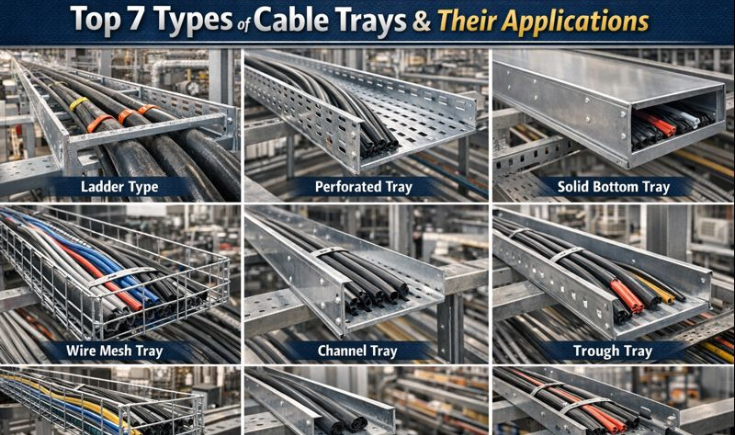
Selecting the right tray helps improve safety, heat dissipation, cable life, and ease of maintenance across industrial and commercial projects. Below are the top 7 types of cable trays and their applications, along with their key advantages.
1. Ladder Type Cable Tray
The ladder type cable tray consists of two side rails connected by rungs, allowing excellent airflow around cables.
- Applications: Power plants and substations, Heavy industrial facilities, Outdoor electrical installations.
- Why Use It: Ideal for heavy power cables and long spans due to high load-bearing capacity and superior heat dissipation.
2. Perforated Cable Tray
A perforated cable tray has a solid bottom with evenly spaced holes that support cables while allowing controlled ventilation.
- Applications: Control rooms, Commercial buildings, Instrumentation and control wiring.
- Why Use It: Provides a neat appearance, good cable support, and moderate airflow for indoor environments.
3. Solid Bottom Cable Tray
The solid bottom cable tray offers complete protection by enclosing cables on all sides, with optional covers.
- Applications: Data centers, Hospitals and clean rooms, Sensitive control systems.
- Why Use It: Protects cables from dust, moisture, and electromagnetic interference.
4. Wire Mesh Cable Tray
A wire mesh cable tray is made from welded steel wires, offering flexibility and quick installation.
- Applications: Data centers, IT and telecom networks, Office buildings.
- Why Use It: Lightweight, easy to modify on-site, and ideal for low-voltage and data cables.
5. Channel Cable Tray
The channel cable tray is a compact and economical solution for light cable loads.
- Applications: Lighting circuits, Instrumentation cables, Small electrical layouts.
- Why Use It: Best suited for short cable runs where space is limited.
6. Trough Cable Tray
A trough cable tray is partially enclosed, offering more cable protection than ladder trays.
- Applications: Power distribution systems, Industrial indoor installations.
- Why Use It: Provides better cable support while maintaining ventilation and reducing cable sag.
7. Single Rail Cable Tray
A single rail cable tray supports cables using a central spine, reducing material usage.
- Applications: Commercial buildings, Retrofit and expansion projects.
- Why Use It: Perfect for tight spaces and flexible routing requirements.
Conclusion
Understanding the different types of cable trays and their applications is crucial for designing safe, efficient, and reliable electrical systems. From ladder trays for heavy-duty power cables to wire mesh trays for data and telecom networks, each type serves a specific purpose.
Selecting the right cable tray ensures long-term performance, compliance with standards, and cost-effective cable management.
FAQ: