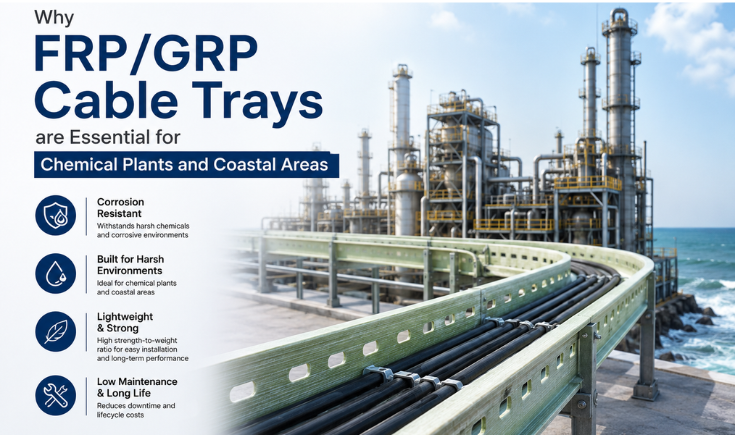
Why FRP/GRP Cable Trays are Essential for Chemical Plants and Coastal Areas
05 Jun 2026 || By: Admin
Introduction to Harsh Environment Cable Management
Harsh industrial environments, such as chemical processing plants, offshore platforms, and coastal facilities, present unique challenges for electrical infrastructure. Standard metal cable management systems often succumb to rapid degradation when exposed to harsh chemicals, saltwater, and extreme humidity. To prevent catastrophic failure,
corrosion-resistant cable trays
become a non-negotiable structural element. Fiber Reinforced Plastic (FRP) and Glass Reinforced Plastic (GRP) trays offer the ultimate long-term solution. As a premierFRP cable tray manufacturer
, Hutaib Electricals engineers advanced, non-metallic cable management systems designed to outlast traditional materials under the toughest conditions.The Science of Survival: What Makes FRP and GRP Different?
FRP and GRP cable trays are manufactured using a highly controlled pultrusion process. This method combines high-strength continuous fiberglass roving with tough thermosetting resins, such as fire-retardant polyester or vinyl ester. This specialized composite structure creates a lightweight yet incredibly durable material that is inherently immune to rust, oxidation, and severe chemical corrosion.
Key GRP Cable Tray Uses in Heavy Industries
The versatility and durability of these materials mean that
GRP cable tray uses
extend far beyond basic wire support. They are an absolute necessity in heavy infrastructure, including:- Chemical and Petrochemical Plants: Where constant exposure to aggressive acids, alkalis, and volatile organic compounds (VOCs) easily destroys standard galvanized steel.
- Offshore Platforms and Oil Rigs: Providing non-conductive, spark-resistant support in highly explosive marine environments.
- Water and Wastewater Treatment Facilities: Enduring the constant moisture, chlorine vapor, and hydrogen sulfide gases typical in sanitation processing.
- Paper and Pulp Mills: Resisting the bleaching agents and highly corrosive chemicals required for industrial paper manufacturing.
Why Corrosion-Resistant Cable Trays are Crucial for Coastal Areas
Facilities located near the coast are constantly battered by salt-laden air and high moisture levels. Saltwater acts as an aggressive electrolyte that rapidly accelerates the oxidation process of traditional metals through galvanic corrosion. Utilizing
corrosion-resistant cable trays
made of FRP ensures that the structural integrity of the electrical routing is perfectly maintained. This prevents dangerous cable sagging, short circuits, and expensive operational downtime. Furthermore, our pultruded composites feature robust UV resistance, ensuring the trays won't become brittle or crack when exposed to relentless coastal sunlight over decades of use.Engineering Advantages Beyond Corrosion
Beyond their immunity to rust and chemical degradation, FRP and GRP trays offer several highly beneficial engineering properties:
- Non-Conductive Properties: They act as excellent electrical insulators, directly enhancing worker safety by eliminating the need for complex grounding/earthing systems.
- High Strength-to-Weight Ratio: They are significantly lighter than their steel counterparts, which makes site installation faster, cheaper, and reduces the dead load on building frameworks.
- Fire Retardancy: They are strictly formulated to self-extinguish and, in the event of a fire, feature low smoke and zero halogen (LSZH) emissions.
Choose Hutaib Electricals as Your Premier FRP Cable Tray Manufacturer
When sourcing critical infrastructure components, reliability and adherence to safety standards are key. As a leading
FRP cable tray manufacturer
in India, Hutaib Electricals designs pultruded FRP and GRP cable trays that meet strict international standards (including NEMA and IEC compliance). Our trays are rigorously factory-tested for ultimate load-bearing capacity, flame resistance, and extreme chemical endurance to guarantee peak performance in your facility.Conclusion
Investing in FRP and GRP cable trays is a strategic engineering decision that drastically reduces the Total Cost of Ownership (TCO) for facilities in aggressive environments. By entirely eliminating rust-related maintenance, repainting, and frequent replacements, chemical plants and coastal infrastructure projects can ensure uninterrupted, safe operations for years to come. Ensure the safety of your site's electrical backbone by choosing advanced composite cable management.
FAQ: