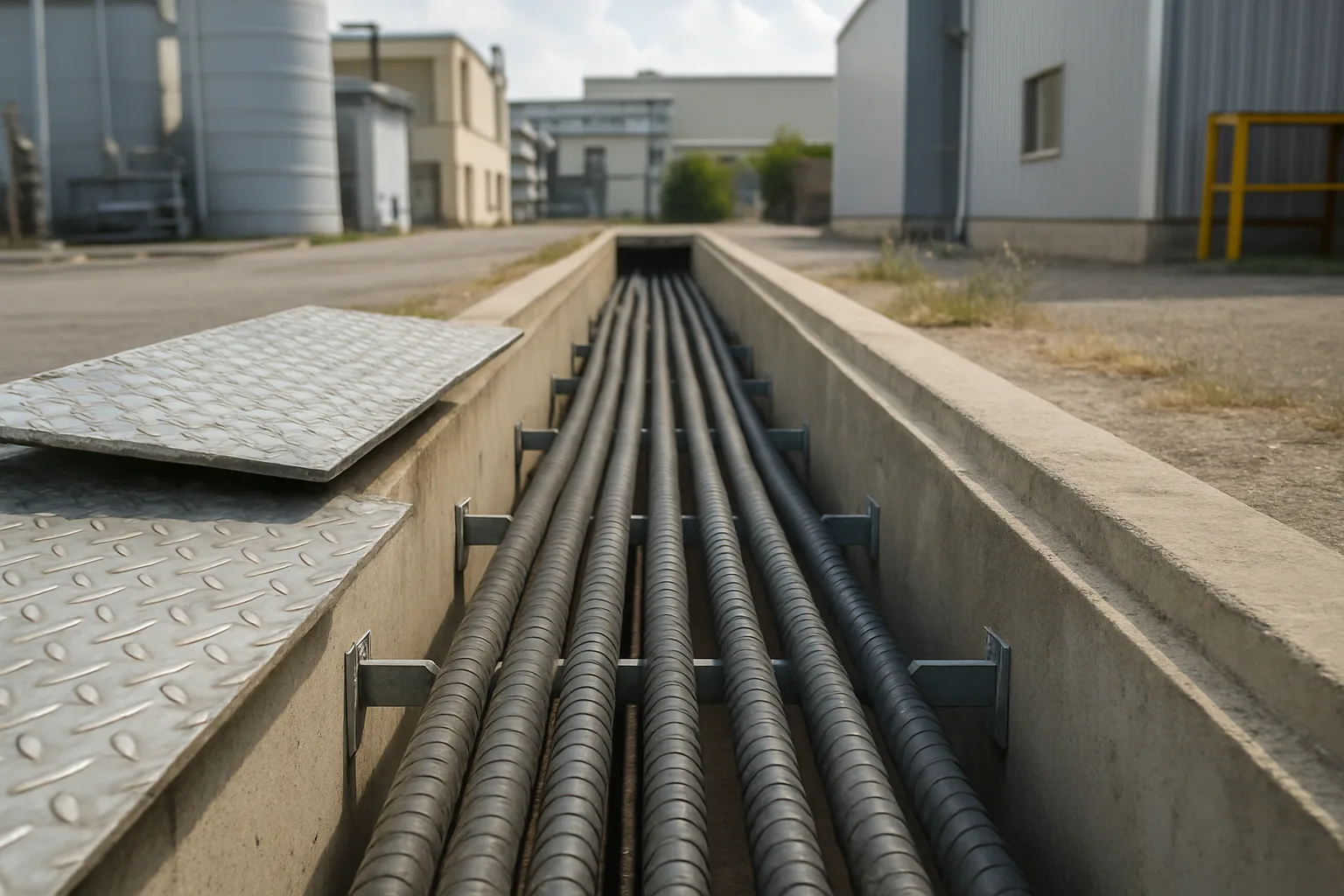
Cable trench vs cable tray: the short answer
A cable trench is a civil structure, an excavated and lined channel below floor or ground level, covered with removable slabs or chequered plate, in which cables are laid on the floor or on brackets. A cable tray is a fabricated steel support system that carries cables above ground along walls, ceilings, structures and pipe racks. Most industrial plants need both: the trench moves bulk power from the substation across yards and under roads, and the tray distributes it inside buildings up to the panels, motors and equipment.
The decision is rarely about which product is better. It is about where the cable has to travel, what has to cross it, and how often somebody will need to get at it again.
What a cable trench actually does
A trench is built by the civil contractor, usually in RCC or brickwork with a plastered finish, and closed with precast covers or steel plates flush with the finished level. Inside it, cables either rest on a sand bed, sit on cleats, or are supported on steel brackets and small tray sections fixed to the trench walls.
Its strengths are physical. A trench keeps heavy multi core power cables out of the way of vehicles, forklifts, cranes and process equipment. It protects them from mechanical damage in yards and roadways. It allows very large bending radii for high voltage cables that simply cannot be turned tightly at high level. And in a hazardous or high traffic area, putting cable below grade removes it from the working envelope entirely.
The weaknesses are equally physical. Trenches collect water, dust, oil and rodents. Covers get concreted over during later civil work. Adding a cable two years after commissioning means lifting slabs, and heat dissipation inside a closed, damp trench is far poorer than in open air, which is why cables laid in groups underground carry derating factors from the cable manufacturer's tables. Indian practice for laying and maintaining power cables up to and including 33 kV is set out in IS 1255, the code of practice most consultants reference for trench and duct installation.
What a cable tray system does
Cable trays support cable the way that roadway bridges support traffic. The run is visible, ventilated, supported at fixed spans and open for future additions. Because trays are fabricated off site in standard lengths, widths, heights and thicknesses, they arrive ready to install and go up on brackets, hangers or unistrut, which is far faster than pouring and curing civil work.
The main types split by duty:
- Ladder type trays for heavy power cables over long support spans, where the rung spacing gives cleating points and maximum air movement. See our ladder cable tray range for welded and bolt and nut construction.
- Perforated trays for mixed power and control cabling that needs a supporting base with ventilation and heat dissipation. The perforated cable tray sizes and finishes are published by width, height and thickness.
- Wire mesh and basket trays for light data, instrumentation and networking cable, particularly in IT rooms and data centres.
- Raceways and trunking where cables must be fully enclosed for appearance or dust protection.
We have written a separate technical comparison covering the difference between a cable tray and a cable trench in more detail if you need the point by point version.
When a project needs a cable trench
Specify a trench when the route has to go under something. Typical cases we see on plants around Pune and the Mumbai belt:
- Substation to plant building runs crossing internal roads and vehicle movement areas.
- Transformer yards and switchyards where HV cables need generous bending radii and mechanical protection.
- Heavy machine shops where nothing can hang at low level over the floor.
- Areas with hot process equipment, molten metal or chemical spillage at high level.
- Sites where architectural or process clearance rules out overhead routing entirely.
Good cable trench design allows for the future. Provide spare width, a floor slope with sump pits for drainage, and wall mounted brackets or short tray sections rather than laying cables directly on the trench floor, so that water sitting at the bottom never touches the cable armour.
When a cable tray is the better choice
Choose tray whenever the cable can travel at high level and the load is likely to change. Inside a factory shed, a data centre, a hospital, a university block or an airport terminal, trays win on three practical counts: cables run in air so they carry closer to their rated current, faults can be traced by eye, and a new circuit can be added in an afternoon without breaking any floor.
Trays also cut programme risk. Civil work has a curing time and a sequence. Tray does not. On fast track projects the electrical contractor can install a complete tray network while the floor is still being finished, which is one of the reasons project teams increasingly move to overhead routing wherever the site permits.
How to combine trench and tray in one industrial installation
On a real plant the two systems are one route. The cable leaves the substation on ladder tray inside the switchgear room, drops into a trench to cross the yard and the road, rises again at the receiving building, and continues on tray to the MCC and the equipment. The design work is in the transitions.
The transition points that decide the job
- Riser design. Where the cable comes out of the trench, use a vertical tray section or a formed riser with a generous radius. Sharp exits at the trench lip damage armour and are the most common failure we are asked to correct.
- Sealing. Every wall or floor penetration between trench and building needs a proper seal against water, rodents and fire spread.
- Support inside the trench. Wall brackets and unistrut channel inside a trench must be as corrosion resistant as the environment demands, because they sit in the wettest part of the whole route. Our unistrut channel systems are used for exactly this bracketing work.
- Continuity of earthing. The earth path must not be interrupted where tray stops and trench starts. Bond across the gap deliberately with a conductor, do not rely on incidental metal contact.
- Segregation. Keep power and control or instrumentation cable on separate tiers, whether the tier is a tray in air or a bracket in the trench.
Finishes: matching the steel to the environment
Underground cable management is a corrosion problem before it is an electrical one. Anything installed in or near a trench is in a damp, sometimes chemically loaded environment, and the finish should be selected accordingly.
- Pre-Galvanised as per IS-277 suits dry indoor tray runs at high level.
- Hot Dip Galvanised as per IS-2629 is the normal choice for outdoor routes, yards, trench brackets and anywhere with regular moisture, because the zinc coating is applied after fabrication and covers cut edges and welds.
- SS 202, SS 304 and SS 316 are used where chemicals, coastal salt air or washdown regimes will attack galvanising. SS 316 is the usual specification for aggressive chemical and marine conditions.
We manufacture all our tray types and accessories in these finishes at Burhani Industrial Area, Pune, with our own quality control and packing units, and we have been doing this since the company was incorporated in 2001.
Getting the specification right for your layout
The most useful thing you can send us is a layout and section drawing showing where the route is below grade and where it is above. From that we can advise tray type, width, height, thickness and finish, and fabricate the bends, tees, crosses, reducers and risers that make the trench to tray transition clean. Where a standard fitting will not sit in your trench profile, we make custom made cable trays and accessories to suit, developed through our in-house R&D, with slotting patterns that allow cutting and joining at any point without drilling at site.
Send your drawings and cable schedule through our enquiry page and our technical team will come back with sizes, finishes and a quotation for supply in Pune, Mumbai, across India and for export.
Frequently asked questions
Is a cable trench cheaper than a cable tray system?
Usually not, once the full scope is counted. A trench involves excavation, RCC or brickwork, covers, drainage and reinstatement, all of which are civil costs with a programme attached. A cable tray system is fabricated off site and bolted to supports, so it installs faster and can be extended later without breaking floors. Trenches earn their cost where cables must cross roads or vehicle areas.
Can cable trays be installed inside a cable trench?
Yes, and it is better practice than laying cables on the trench floor. Short perforated or ladder tray sections fixed to the trench walls on brackets keep cables clear of standing water, maintain spacing between circuits and allow separate tiers for power and control cable. For that duty we recommend Hot Dip Galvanised as per IS-2629 or a stainless grade, depending on the environment.
Which finish should I specify for underground cable management steelwork?
Hot Dip Galvanised as per IS-2629 is the normal choice for trench brackets, outdoor runs and damp areas because the coating is applied after fabrication and protects cut edges and welds. Pre-Galvanised as per IS-277 is intended for dry indoor high level runs. Where chemicals, washdown or coastal salt air are present, SS 304 or SS 316 is specified instead.
How do I handle earthing where a cable tray meets a cable trench?
Treat the transition as a deliberate bonding point. Run a bonding conductor across the gap between the tray run and the steelwork inside the trench so the earth path stays continuous, rather than depending on incidental metal to metal contact at a riser. Continuity should be verified after installation, not assumed.
Do you supply cable trays and trench brackets outside Pune?
Yes. We are Manufacturer, Supplier and Exporter of cable trays from Burhani Industrial Area, Pune, supplying across Pune, Mumbai, the rest of India and export markets worldwide. Send your layout drawing and cable schedule and we will advise sizes, thicknesses and finishes along with delivery timelines.