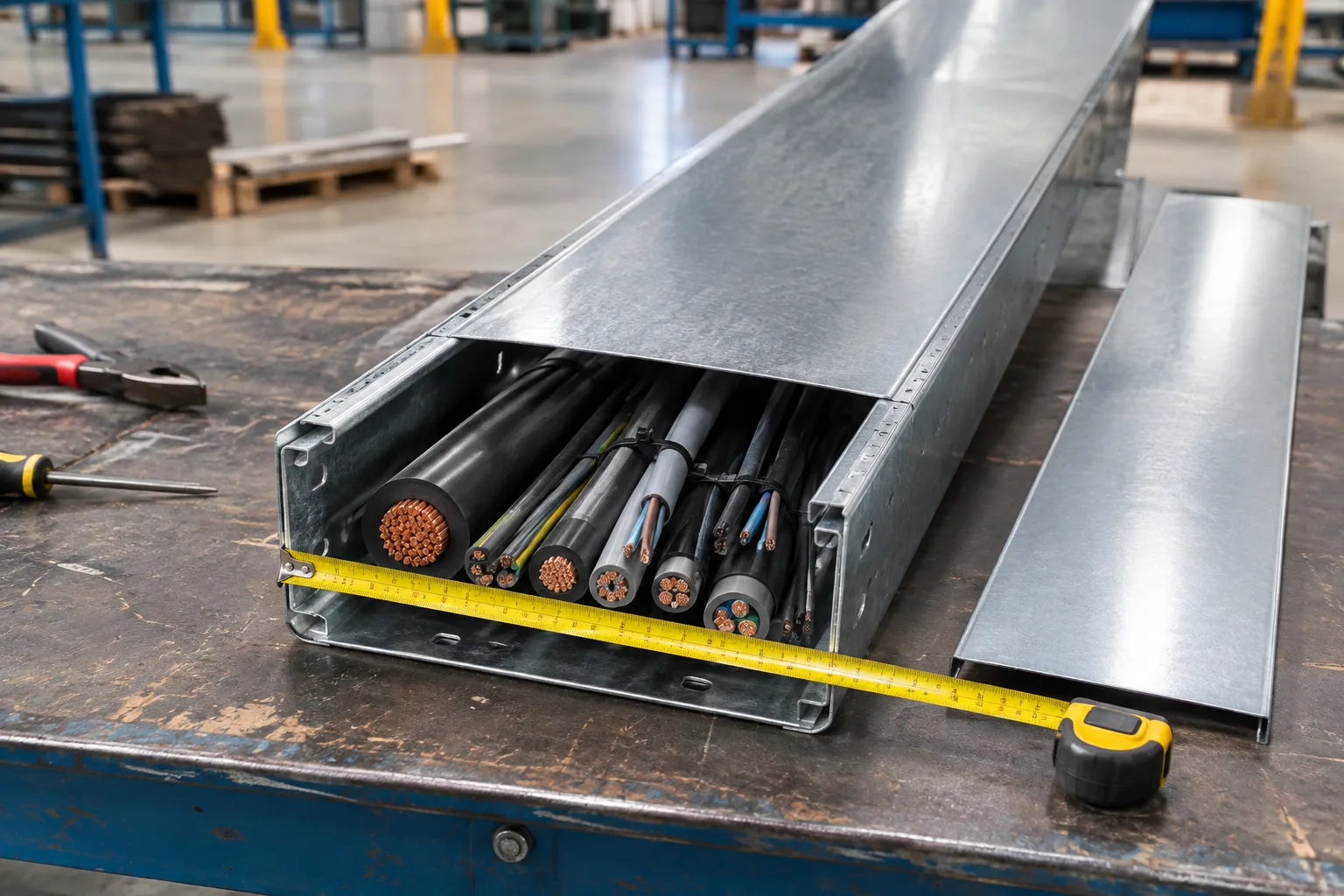
Electrical raceway sizes are chosen from the total cross-sectional area of the cables it must carry, divided by an allowable fill limit, with spare capacity added for future circuits. Width and depth are then set by mounting space, cable bending radius and segregation needs. GI sheet thickness follows from the raceway width, support spacing, cable weight and the site environment.
Hutaib Electricals has manufactured cable management products in Pune since 2001. This guide explains how we approach raceway sizing with electrical contractors, EPC firms and procurement teams on industrial and commercial projects.
What Is an Electrical Raceway (Cable Raceway)?
A raceway is an enclosed channel that carries and protects electrical cables between panels, equipment and distribution points. On site the terms cable raceway, raceway tray, raceway cable tray and trunking are often used for the same family of products: a U-shaped steel body with a removable or snap-fit cover. Unlike an open perforated or ladder tray, an electrical cable raceway encloses the cables, which protects them from dust, falling objects and accidental contact, and gives a neater finish in visible areas.
Raceways are widely used in factories, commercial buildings, control rooms, data centres and warehouses. You can see our full range, including GI cable trunking and powder coated options, on the raceway cable trays in India page.
How Cable Fill Decides Electrical Raceway Sizes
Cable fill is the share of the raceway's internal cross-section that the cables occupy. Fill is kept well below 100% so cables can be pulled in without damage, heat can escape, and new circuits can be added later.
Fill limits used in practice
There is no single universal figure, so always follow the project specification or the consultant's design basis. Two commonly referenced norms are:
- NEC Article 376.22 (USA, metal wireways): the sum of the cross-sectional areas of all conductors at any point shall not exceed 20% of the wireway's interior cross-sectional area.
- IET guidance under BS 7671 (UK): a space factor of 45% is the usual limit for cable trunking, meaning cables should occupy no more than 45% of the internal area.
Indian projects often adopt one of these approaches, or a client-specific value, in their electrical specifications. The lower 20% figure leads to larger sections and more heat margin; the 45% figure gives more compact raceways for lighter loads such as control and data cabling.
A step-by-step sizing method
- List every cable on the route with its overall diameter from the cable manufacturer's data sheet.
- Calculate each cable's area using π x (diameter / 2)².
- Add the areas for the total cable cross-section.
- Divide by the fill limit (for example 0.45 or 0.20) to get the minimum internal area required.
- Add spare capacity for future circuits, as defined in the project specification.
- Select the nearest standard width and depth that meets or exceeds this area.
Worked example: twenty cables of 20 mm overall diameter each have an area of about 314 mm², giving a total of roughly 6,280 mm². At a 45% space factor the raceway needs at least about 13,960 mm² of internal area, so a section such as 150 x 100 mm (15,000 mm²) would work before spare capacity. At a 20% fill limit the requirement rises to about 31,400 mm², pointing to a larger section such as 300 x 150 mm. The same cables, two very different sizes, which is why the fill basis must be agreed before ordering.
Width vs Depth: Practical Points for Industrial Cable Raceway
Once the minimum area is known, the proportion of width to depth matters as much as the total.
- Heat and stacking: deep raceways encourage cables to stack in many layers, which traps heat in power circuits. A wider, shallower section usually helps power cables lie in fewer layers.
- Bending radius: large power cables need room to bend at elbows and tees. Check the cable manufacturer's minimum bending radius against the raceway depth and the fittings you plan to use.
- Mounting space: wall-mounted runs in corridors and plant rooms are often limited in width, while ceiling runs may be limited in depth by beams and ducts.
- Segregation: where power, control and instrumentation cables share one route, a divider or separate compartments keep them apart. Each compartment must be sized for its own fill.
Our product page lists the available raceway and trunking tray types so you can match the calculated section to a standard size. Where the layout needs a non-standard section, we fabricate custom made cable trays and raceways through our in-house R&D.
Choosing GI Sheet Thickness for an Electrical Cable Raceway
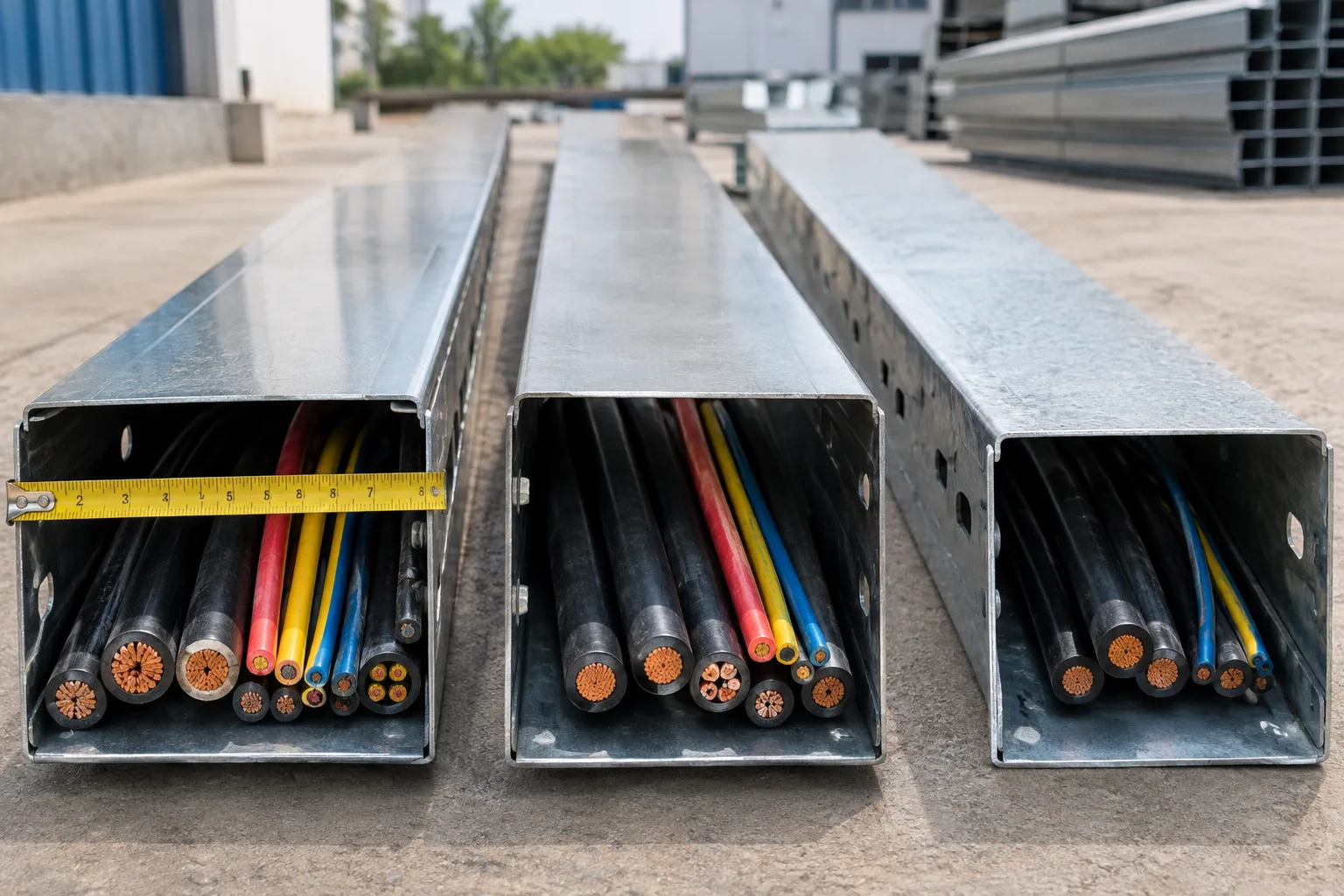
Sheet thickness controls stiffness, load-bearing behaviour and resistance to site handling damage. As a manufacturer we look at four factors:
- Width of the raceway: a wider base flexes more under the same cable weight, so wider sections generally need heavier sheet.
- Support spacing: longer spans between brackets or channels increase deflection. If supports are widely spaced, either increase thickness or add supports.
- Cable weight: armoured power cables are far heavier than control or data cables of similar diameter.
- Handling and cover fixing: thin sheet can dent during transport and installation, and covers on thin bodies may not seat properly.
Selecting the right raceway depends on cable load, installation environment, support spacing, material and required finish, so thickness should never be chosen on price alone.
Material, thickness and finish
- Pre-galvanised to IS-277: suitable for indoor, dry areas such as commercial buildings and clean factory floors.
- Hot dip galvanised to IS-2629: the zinc is applied after fabrication, so cut edges and slots are also coated. Preferred for outdoor, humid and coastal sites such as those around Mumbai and Navi Mumbai.
- Powder coated or painted: used where colour coding or a finished appearance is required.
- Stainless steel SS 202, 304 or 316: for chemical, food, pharma and other corrosive environments.
Raceway, Trunking or Cable Tray: Which Suits Your Route?
An enclosed raceway is not always the right answer. Heavy power runs in large plants often suit open ladder or perforated trays, which dissipate heat better and are easier to inspect. Raceways suit areas where protection, appearance or segregation matters more. Our comparison of raceways vs traditional cable trays covers the trade-offs in detail, and the guide to the types of electrical trunking explains which form fits each application. For a broader overview, read our article on raceway and cable tray trunking.
Do Not Forget Accessories and Fittings
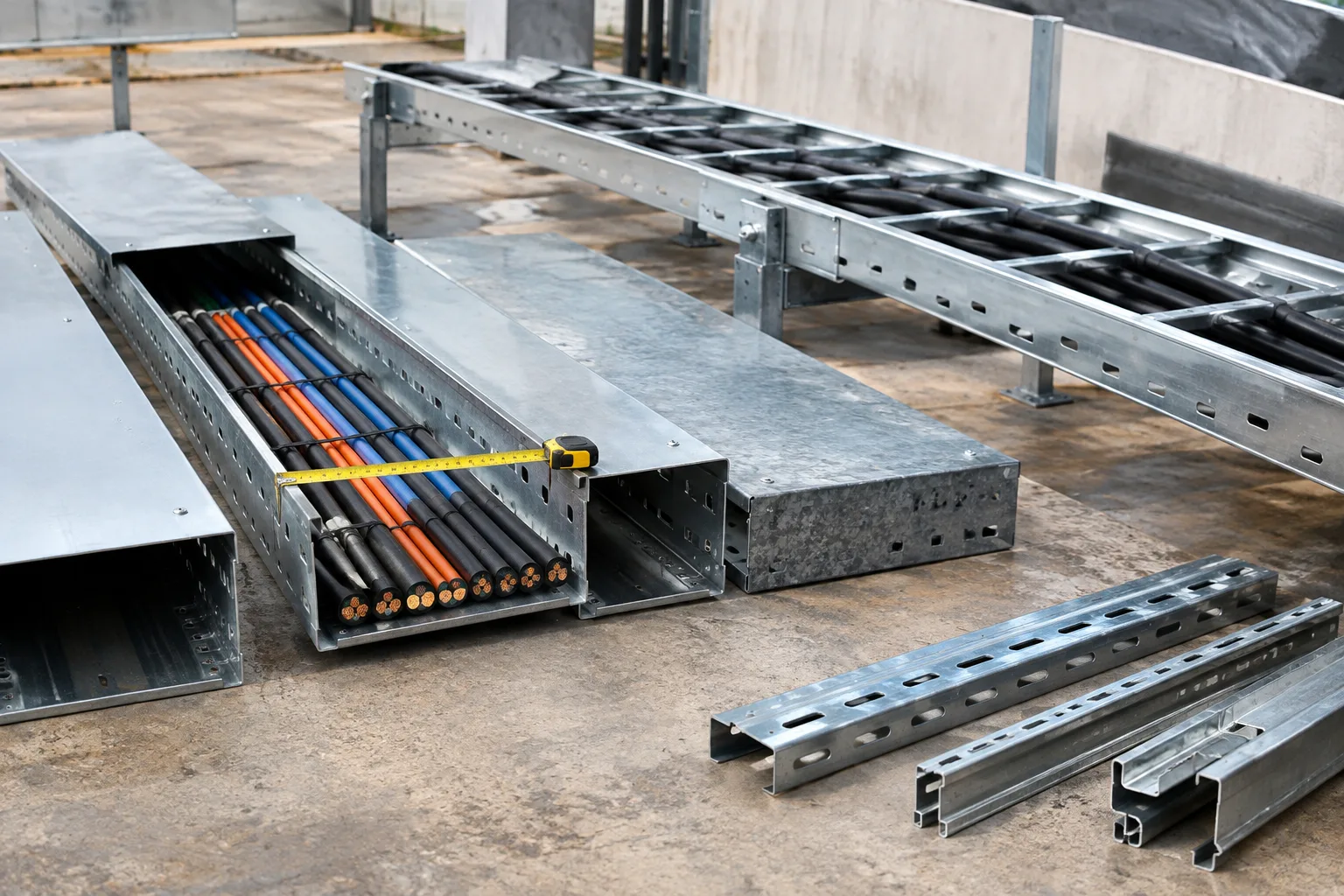
A raceway run is only as good as its bends, tees, reducers and couplers. Fittings must match the straight section in width, depth, thickness and finish, otherwise covers will not align and cables can be damaged at joints. Where a route changes size, use a proper reducer rather than site-cut transitions. Hutaib Electricals makes fittings in single-piece construction wherever possible, which reduces joints and keeps cable paths smooth.
What to Send for a Raceway Quotation
As a cable raceway manufacturer supplying Pune, Mumbai, pan India and export markets, we can quote faster and more accurately when we receive:
- Cable schedule or the calculated internal area and fill basis
- Required width, depth and length per section
- Sheet thickness, or support spacing and cable weight so we can advise
- Finish: IS-277 pre-galvanised, IS-2629 hot dip galvanised, powder coated or stainless steel grade
- Fittings list with quantities and any compartment or divider needs
- Delivery location and project schedule
For bulk cable tray requirements or custom fabrication, share your drawings, technical specifications and quantities with our team to request a quotation.
Frequently asked questions
What fill percentage should I use when sizing an electrical raceway?
Follow the project specification first. Common references are NEC Article 376.22, which limits metal wireway fill to 20% of the interior area, and IET guidance under BS 7671, which uses a 45% space factor for trunking. The lower figure gives more heat margin and spare room.
Is a deeper raceway better than a wider one?
Not always. Deep sections cause power cables to stack in many layers, which traps heat. A wider, shallower raceway usually suits power cables, while depth is more acceptable for lighter control and data cables.
Which finish should I choose for outdoor GI cable trunking?
For outdoor, humid or coastal sites, hot dip galvanised to IS-2629 is generally preferred because the zinc coating is applied after fabrication and covers cut edges. Pre-galvanised to IS-277 is better suited to indoor, dry areas. Stainless steel is used for chemically aggressive environments.
Can Hutaib Electricals make raceways in non-standard sizes?
Yes. We manufacture custom made cable trays and raceways through our in-house R&D, based on project-specific dimensions and requirements. Share your drawings and cable schedule and we will confirm feasibility and quote.
Do you supply raceways outside Pune?
Yes. We supply Pune, Mumbai, Navi Mumbai, Thane, the rest of Maharashtra and pan India, and export to markets including the UAE, Nepal, Bangladesh and Bhutan.