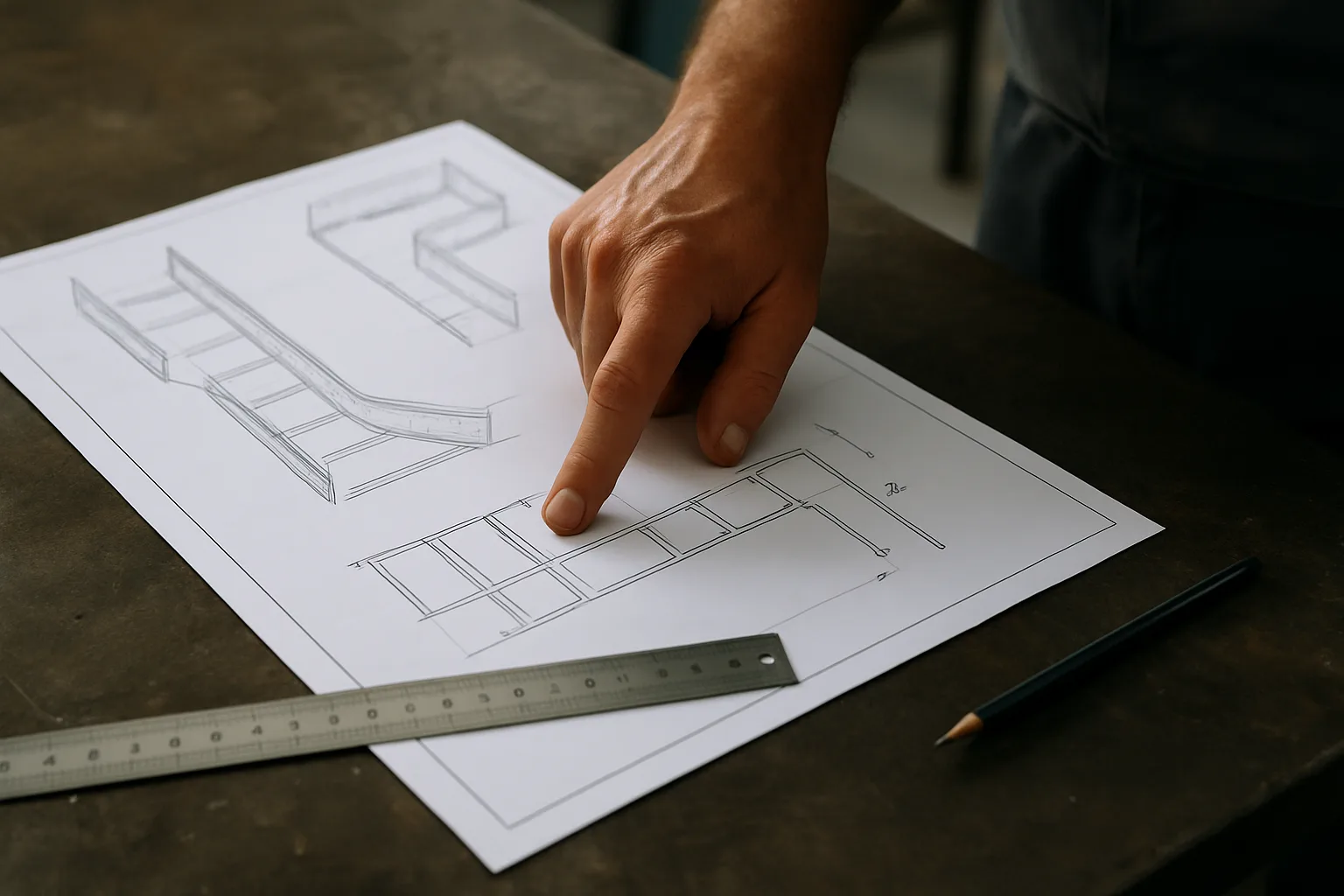
Ordering custom made cable trays follows six steps: you send a marked up layout and section drawing with your cable schedule, we review manufacturability and quote, you approve a fabrication drawing, we make and offer a first sample or first piece for approval, we fabricate the balance quantity in the agreed finish, and we pack and dispatch. The two items that decide your delivery date are the finish (a hot dip galvanised batch takes longer than a pre-galvanised one) and how quickly the drawing is approved. Minimum order quantity on non standard work is set per item, because every custom section needs its own tooling setup, not because of a fixed rule.
Below is what each stage actually involves, written from the way we run custom jobs at our Pune works.
Step 1: Send the drawing, layout and section
A custom cable tray manufacturer cannot quote from a width and a length alone. What we need is a layout drawing showing the route and a section showing the tray with the services around it. On that drawing, mark the following:
- Tray type required: perforated, ladder type, wire mesh basket or trunking and raceway.
- Width, side height and sheet thickness, or the cable schedule so we can work the width out for you.
- Bend angles and radii, elevation changes, and whether bends are horizontal or vertical.
- Support spacing available on site, plus the structure you are fixing to (RCC slab, purlin, gantry, pipe rack).
- Finish: Pre-Galvanised as per IS-277, Hot Dip Galvanised as per IS-2629, powder coated, painted, or stainless steel in SS 202, 304 or 316.
- Obstructions: the beam, duct or drain that made the layout non standard in the first place.
A hand marked print or a photograph of the site with dimensions written on it is perfectly workable at enquiry stage. Cable trays support cable the way roadway bridges support traffic, so what we are really reading from your drawing is span, load and route, then converting that into a fabricated section. If you are still deciding between tray types, our full product range with published sizes and thicknesses is the quickest way to check whether a standard section already covers your need before you pay for custom work.
What counts as non-standard cable tray fabrication
In the world of cable management, one size does not fit all. Most enquiries we treat as non-standard cable tray fabrication fall into a handful of patterns:
- A width, height or thickness outside the published standard range, usually because a cable schedule sits awkwardly between two sizes.
- A cable tray for non-standard project layout: odd angle bends, offsets around structural steel, tight radius turns in a plant room, or reducers that also change elevation.
- Fittings that need to be made in single piece construction rather than assembled from segments, which is how we prefer to make them wherever the geometry allows.
- Special hole and slotting patterns, so that cutting and joining is possible at any point without drilling at site.
- Unistrut and hi-tech channel lengths, hole patterns and bracket assemblies made to a support drawing.
- Junction boxes, draw boxes and floor boxes sized to a specific gland plate or cable entry arrangement.
Custom does not always mean a new tray. Often the tray stays standard and only the fittings change. In that case, look through cable tray accessories such as bends, elbows, tees, crosses and reducers first, because a stock accessory plus one custom transition piece is usually faster and cheaper than a fully custom run. There is more on how special sections are developed in our note on custom cable tray manufacturing.
Tolerances: agree them on the drawing, not on site
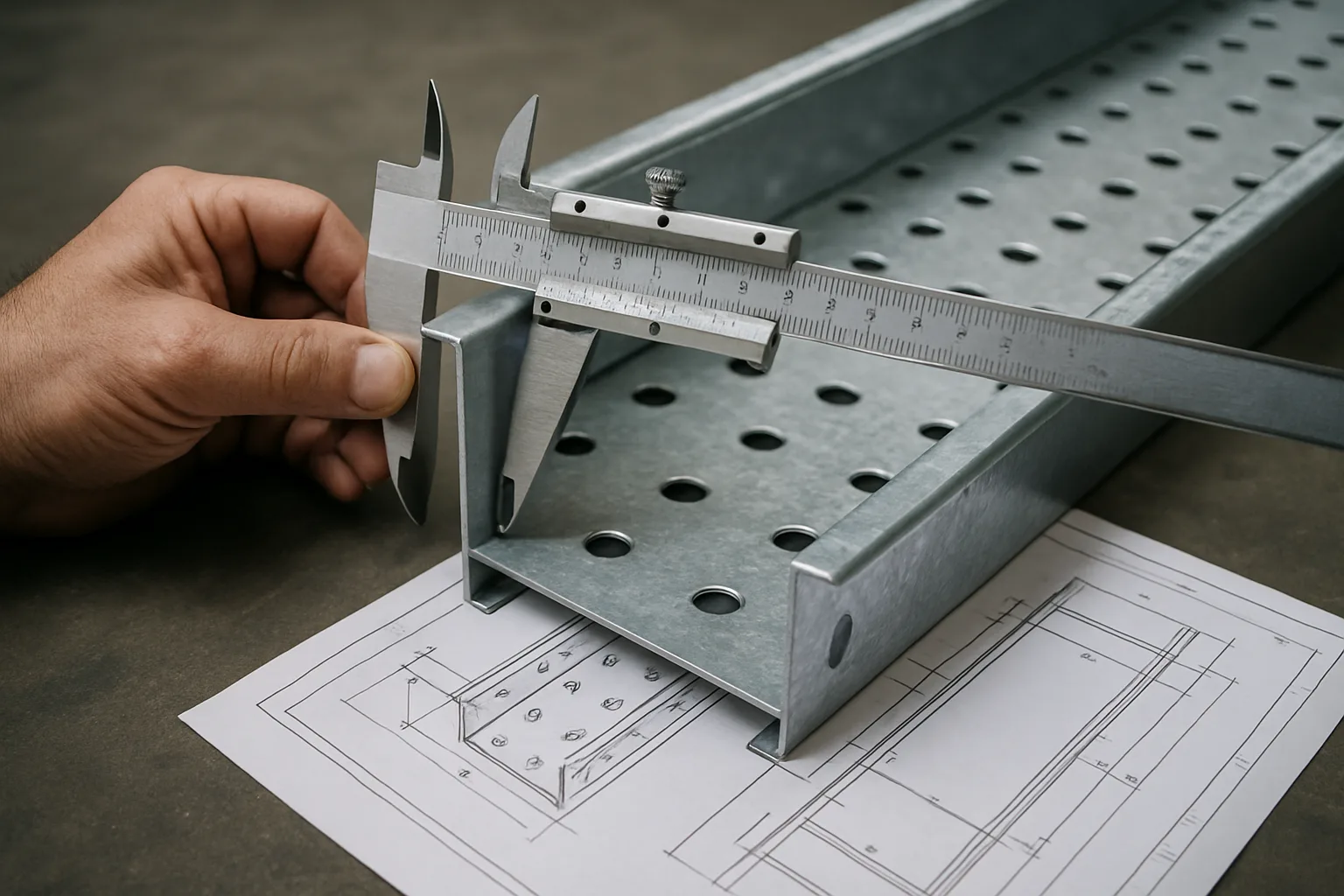
Sheet metal fabrication is not machining. Cut lengths, bend angles and hole centres all carry a working tolerance, and the honest way to handle it is to write the tolerance on the approved drawing before production starts. Three practical points we discuss with project engineers:
- Nominate the critical dimension. On a tray that has to fit between two fixed obstructions, tell us which dimension is the one that must hold, and we will let the others take up the slack.
- Allow for coating build up. Hot dip galvanising to IS-2629 deposits zinc inside holes and on faying surfaces, so bolt holes and slots on hot dipped items need clearance designed in. Pre-galvanised material to IS-277 does not change dimension after forming, which is one reason it suits close fitting trunking and raceway work.
- Cumulative length matters more than piece length. A long straight run is set out from joint to joint, so if the total run length is fixed, say so, and we will supply a made to measure closing piece rather than leaving site to cut and file.
Our quality control unit checks dimensions, hole positions and finish in house before packing, and anything outside the agreed tolerance is reworked at the works, not at your site.
Sample approval and first piece checking
For repeat quantity items, we recommend a first piece or sample approval before the balance goes into production. On a custom bend, a sample tells you in five minutes what a drawing cannot: whether the cable bending radius is comfortable, whether the coupler line matches the adjoining standard tray, whether the fixing holes land on your existing brackets. Approval can be handled by physical sample despatch, by photographs with a steel rule in frame, or by your inspector visiting our unit at Burhani Industrial Area in Pune.
Once the first piece is approved, that piece becomes the reference for the batch. This is the single most effective step for avoiding rework, particularly on export orders where a mismatch discovered after shipping is expensive to correct.
Lead times: what actually drives them
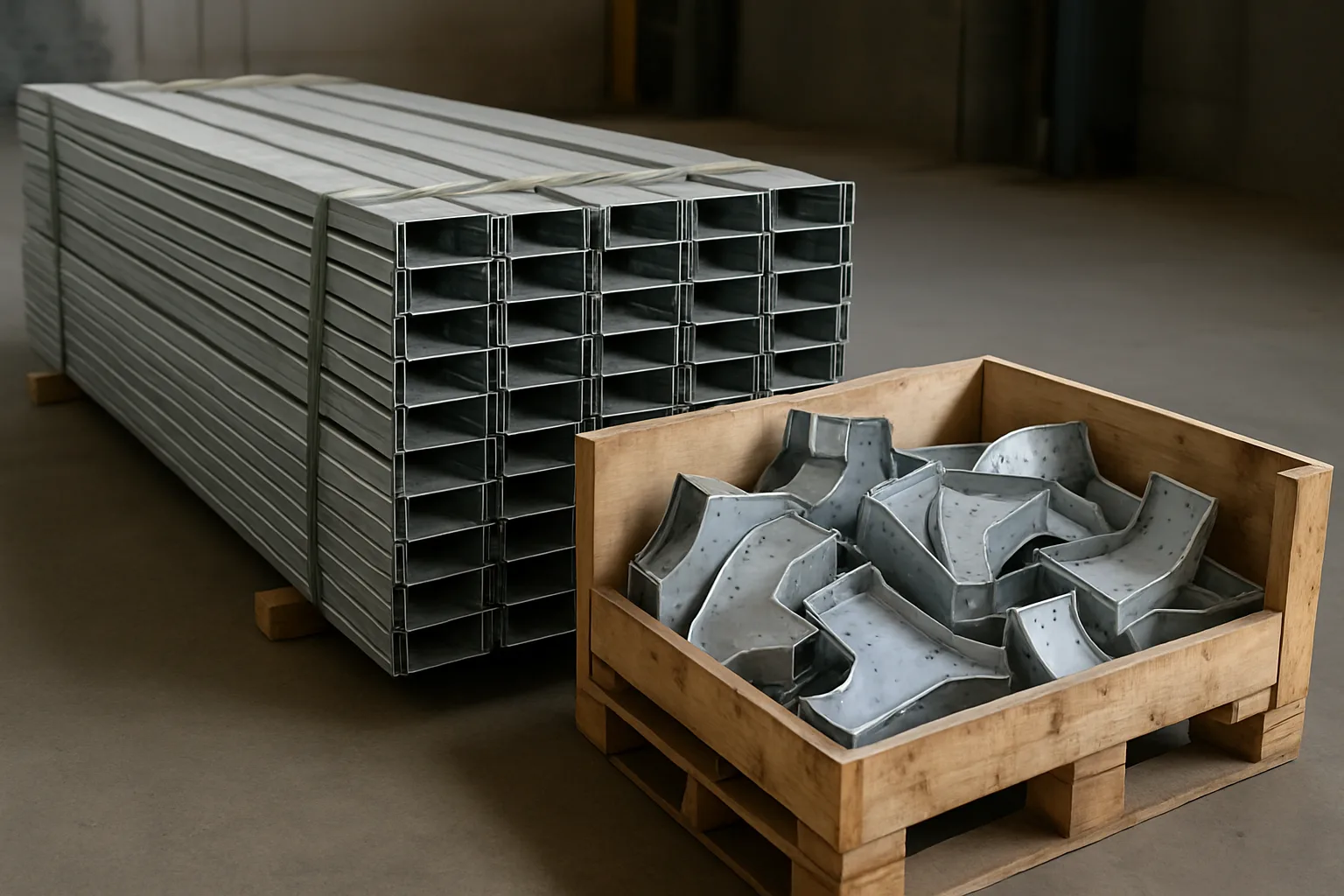
We quote lead time against a specific enquiry rather than publishing a blanket figure, because the same tray in two finishes has two different delivery dates. The variables are:
- Drawing approval time. Production starts from the approved drawing. This is usually the longest and most controllable part of the cycle.
- Finish. Pre-galvanised material is formed from coated sheet and moves straight to packing. Hot dip galvanising to IS-2629 is a separate dipping process with batch scheduling, so it adds time. Powder coating and stainless steel grades sit in between depending on material availability.
- Quantity and section mix. A single tray type in volume runs faster than fifty different fittings, because each custom fitting needs its own setup.
- Material thickness and grade. Standard MS and GI gauges are readily available. SS 304 and SS 316 in a specific thickness may need procurement time.
- Packing and despatch. Export consignments need seaworthy packing from our packing unit, which is part of the schedule, not an afterthought.
Practical advice for EPC and contracting teams: split your order. Release the long straight runs early against a standard section, and let the custom fittings follow once site dimensions are confirmed. That way, installation can begin while the specials are in fabrication.
Minimum order quantity on custom work
Minimum order quantity on custom made cable trays and accessories is item specific and quoted with the offer. The reason is simple. A custom section requires a tooling and machine setup, so the setup cost per piece falls sharply with quantity. One off specials are certainly made, and we do them regularly for retrofit and modification jobs, but the per piece rate reflects the setup. If you need only one or two pieces, tell us at enquiry stage and we will suggest whether a modified standard item can do the same job at a lower cost.
Two ways buyers keep custom costs sensible: standardise on as few widths as the cable schedule allows, and use the same finish across the package so material and galvanising are batched together.
Working with a Pune based custom cable tray manufacturer
Incorporated in 2001, we are Manufacturer, Supplier and Exporter of cable trays with our own manufacturing, quality control and packing units under one roof, plus in house R and D for industrial fabrication work in Pune and custom development. Because the design, fabrication and inspection happen in the same premises, a drawing query is settled the same day rather than passing between a trader and an unknown workshop.
We supply across Pune and Mumbai, throughout India and to export markets, and our trays are designed by taking care of cable loads and practical site problems rather than catalogue geometry alone. To start a custom enquiry, send your layout, section and cable schedule through our enquiry and quotation page, and mention required finish, quantity and site delivery date. If your project also needs support steelwork, our unistrut channel and bracket systems can be fabricated to the same drawing package so tray and support arrive matched.
Frequently asked questions
What drawings do you need to quote custom made cable trays?
A layout drawing showing the route and a section showing the tray with surrounding services are enough to begin. Mark width, side height, thickness, bend angles, elevation changes, support spacing and required finish, and attach the cable schedule if the width is not yet fixed. A dimensioned hand sketch or a marked site photograph is acceptable at enquiry stage.
Is there a minimum order quantity for non-standard cable tray fabrication?
Minimum order quantity is set per item and quoted with the offer, because each custom section needs its own tooling and machine setup. Single pieces and small lots are made regularly for retrofit and modification work, but the rate per piece reflects that setup. If your quantity is small, ask us whether a modified standard section can meet the same requirement more economically.
How long do custom cable trays take to manufacture?
Lead time is quoted against the specific enquiry, since finish and quantity change it substantially. Pre-Galvanised material as per IS-277 moves from forming to packing, while Hot Dip Galvanised work as per IS-2629 involves a separate dipping batch and takes longer. The fastest way to shorten the cycle is to approve the fabrication drawing quickly.
Do you offer sample approval before full production?
Yes. For repeat quantity items we recommend a first piece or sample approval, which can be done by sample despatch, by dimensioned photographs, or by your inspector visiting our unit in Pune. Once approved, that piece becomes the batch reference and is checked by our quality control unit before packing.
Do you supply custom cable trays outside Pune and Mumbai?
Yes. We manufacture at Burhani Industrial Area in Pune and supply across India as well as to export markets, with seaworthy packing handled by our own packing unit. Export orders are best placed with sample or first piece approval so that dimensions are confirmed before shipping.