What ladder cable tray load capacity actually means
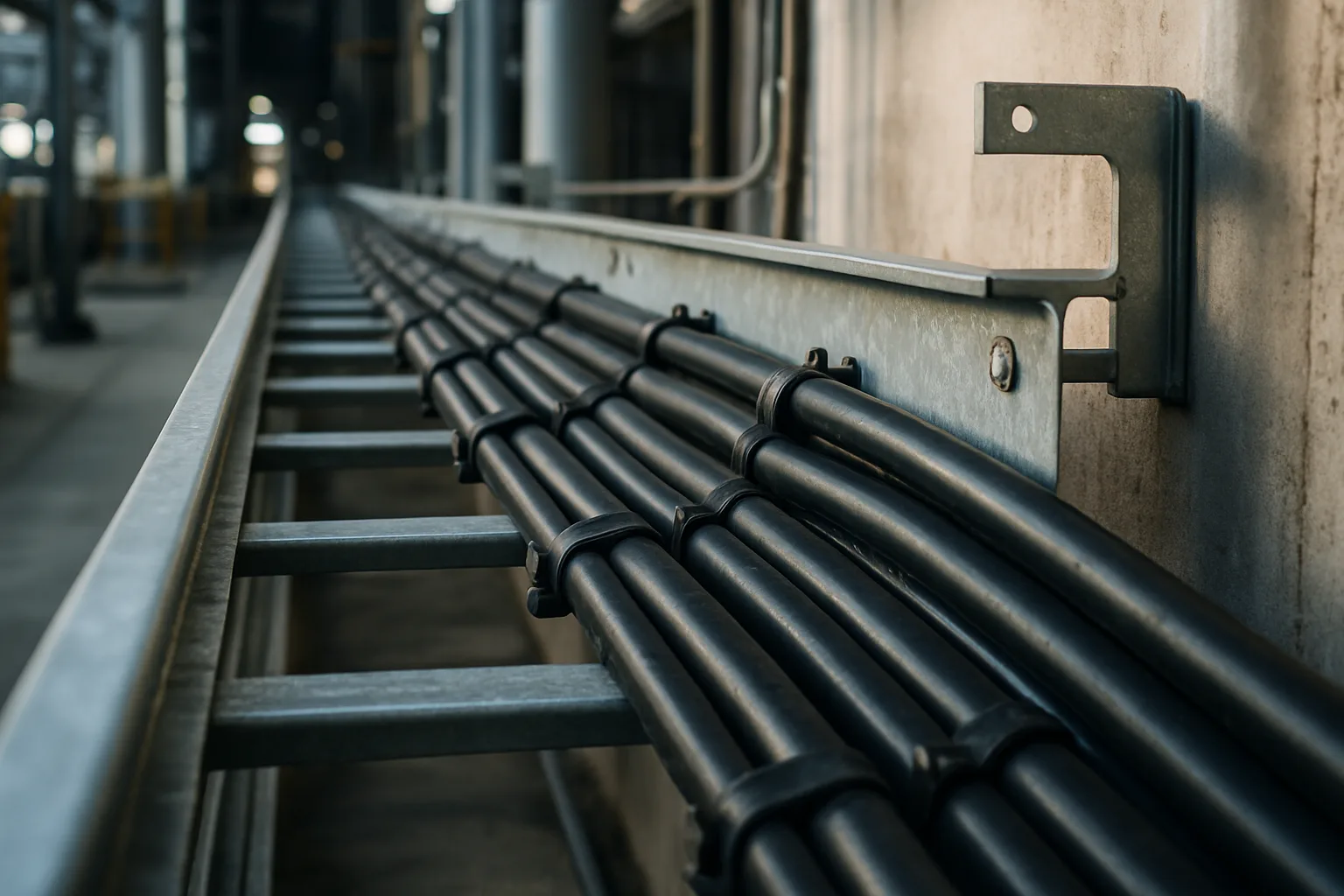
Ladder cable tray load capacity is not a single number printed on a tray. It is a load figure that is only valid at a stated support span, with a stated side rail depth, thickness and rung spacing. Change any one of those and the safe working load changes with it. This is the single most common reason trays deflect on site even though the drawing said the tray was "heavy duty".
Capacity is normally expressed as a uniformly distributed load, in kilograms per running metre, at a given span between supports. So a tray rated for a certain load at a 1.5 metre span will not carry the same load if the site team stretches supports to 3 metres because a beam was in the way. Cable trays support cable the way that roadway bridges support traffic. A bridge span is designed for a load, and doubling the gap between piers halves nothing gently, it changes the whole calculation.
As ladder cable tray manufacturers in Pune, we get asked for "the strongest tray" far more often than we get asked for the span. The span is the question that matters.
The three variables that decide ladder cable tray load capacity
1. Support span
Span is the centre to centre distance between two supports, brackets or hangers. Load capacity falls sharply as span increases, because deflection increases with the span. Two practical points for the specification stage:
- Fix the span first, then select the side rail depth and thickness, not the other way round.
- Keep splice joints near the quarter point of a span rather than at mid span, where bending stress is highest.
- If site conditions force one long span (crossing a road, a duct bank or a plant aisle), tell us at the enquiry stage so that section can be fabricated to suit rather than patched later.
2. Side rail depth and sheet thickness
The side rails, not the rungs, carry the load along the run. Depth (the height of the rail) gives you stiffness, and thickness gives you strength and resistance to local buckling at bracket points. A deeper rail in the same thickness will usually carry more at the same span than a shallow rail in a heavier gauge, which is why "just increase the thickness" is not always the correct answer. Both matter, and our published cable tray standard sizes and thickness ranges for ladder trays are there so that engineers can match rail height, width and gauge to the span they actually have.
3. Rung spacing
Rung spacing does not carry the run load, it carries the cable between rails and controls how much the cable sags between supports. Closer rung spacing is specified when:
- Cables are small diameter or flexible control and instrumentation cables that would otherwise sag.
- The run is vertical, where cables are cleated to rungs.
- The tray is in a public or walkway area where sag is unacceptable.
Wider rung spacing gives better ventilation and heat dissipation and lower cost per metre, which is exactly why ladder type trays are preferred for heavy power cables in plants. The rung is also the fixing point for cleats and ties, so spacing has to line up with the cleating pitch in the cable schedule.
Welded ladder cable tray or bolt and nut ladder cable tray?
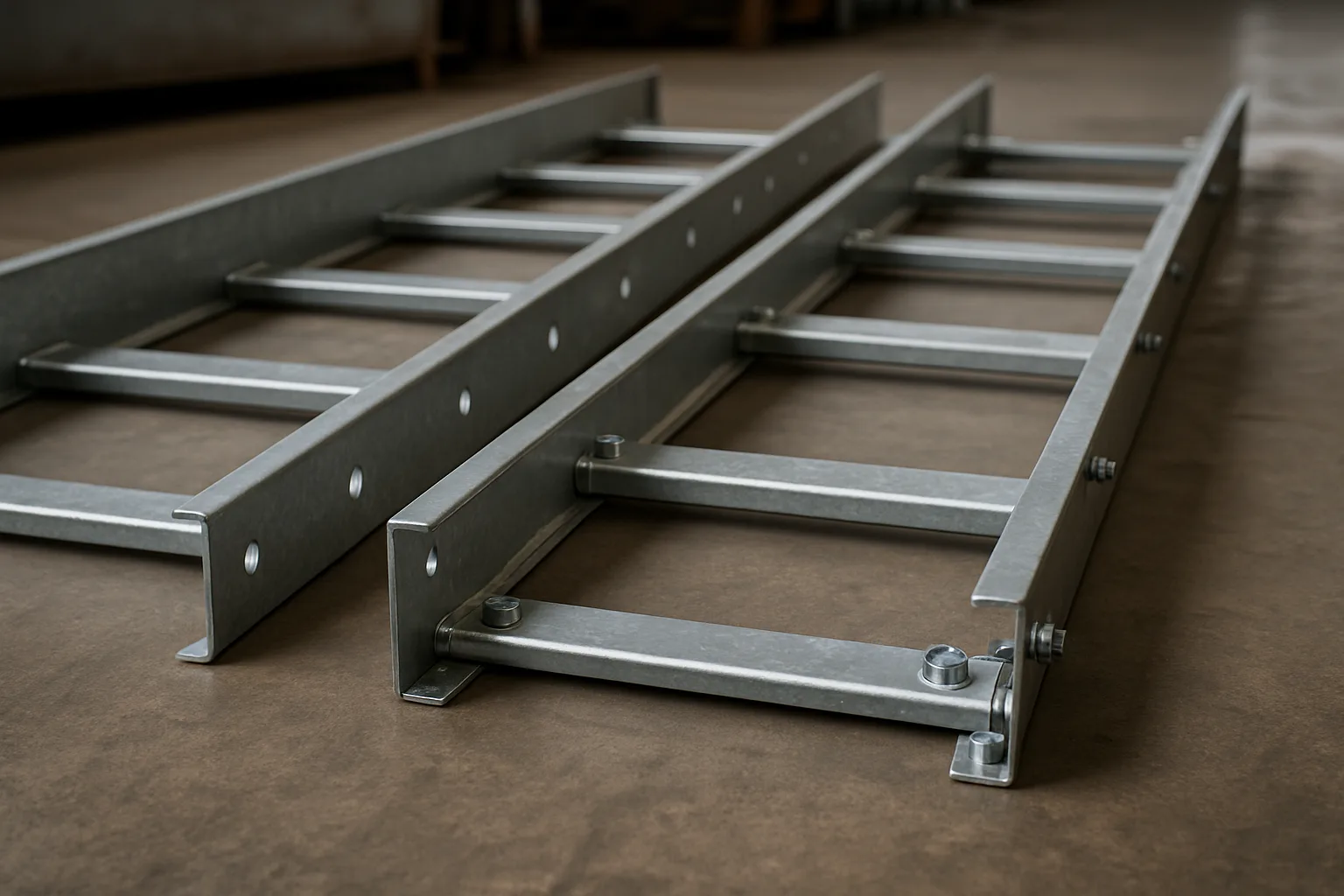
Both types can be manufactured to the same load class. The difference is in fabrication, transport and site handling.
A welded ladder cable tray has rungs welded to the side rails. It arrives as a finished, rigid unit and there is nothing for the site team to assemble. Where the tray is hot dip galvanised as per IS-2629 after welding, the coating covers the weld area as well, which is useful in outdoor and washdown areas.
A bolt and nut ladder cable tray has rungs fixed with fasteners. It is convenient for long export consignments and remote sites because it can be shipped flat and assembled at site, and a damaged rung can be replaced without cutting. It also allows rung spacing to be adjusted where a layout changes on site.
For projects going out of Pune and Mumbai to other states or to export markets, including buyers in the Gulf and UAE, we discuss both options at the quotation stage because packing volume and site labour often decide the choice more than load does. A word of caution on the site assembled type: torque and correct washers matter. Loose fasteners at the rung do not reduce span capacity, but loose splice plates certainly do.
How to work out the load your run will carry
Before a purchase order is released, work through this sequence:
- Add up the cable weight. Take the cable schedule, add the weight per metre of every cable in that tray, and keep the total for each tray width.
- Add the incidental load. Allow for a concentrated load at mid span for a person standing on or pulling from the tray during installation, plus any wind or snow load for outdoor runs.
- Confirm the actual support span from the structural drawing, not from the ideal spacing on the tray layout.
- Select rail depth, thickness and width that satisfy that load at that span, with the deflection limit your consultant has specified.
- Check fill, not just weight. A tray that is mechanically fine can still be overfilled for heat dissipation. Overloading is a safety issue as much as a structural one, as we explain in our note on the electrical safety hazards of overloading cable trays.
- Apply the same load class to fittings. A bend, tee or reducer is often the weakest point in a run because it interrupts the side rail. We make fittings in single-piece construction wherever possible for this reason, and horizontal bends in particular need support on both sides of the radius.
Finish, corrosion and long term capacity
Load capacity assumes the steel section stays intact. Corrosion reduces effective thickness, so the finish is part of the load decision, not a cosmetic choice. We supply ladder trays pre-galvanised as per IS-277 for indoor and dry areas, hot dip galvanised as per IS-2629 for outdoor, coastal and chemically loaded areas, powder coated or painted for architectural and interior exposure, and stainless steel in SS 202, 304 and 316 for aggressive process environments. For hot, humid and coastal sites, including many projects in export markets, the heavier zinc coating of hot dip galvanising is usually the sensible specification.
What to ask a ladder type cable tray manufacturer before you release the order
A serious enquiry to any ladder type cable tray manufacturer should get clear answers to these:
- What load, in kg per metre, at what span, for the exact section you are quoting?
- What is the side rail height, sheet thickness, tray width and rung spacing?
- Is it a welded ladder cable tray or bolt and nut ladder cable tray, and how will it be packed?
- Which finish, to which standard, and what is the coating on cut ends and fittings?
- Are bends, tees, crosses and reducers supplied to the same load class and radius as the straight run?
Incorporated in the year 2001, we Hutaib Electricals manufacture, supply and export cable trays from Burhani Industrial Area in Pune, with our own manufacturing, quality control and packing units. Because the fabrication is in house, we also make custom made cable trays and accessories through our own R&D, with slotting patterns that enable easy cutting and joining at any point without drilling at site. In the world of cable management, one size does not fit all, and a tray designed around your actual cable loads is cheaper over the life of the plant than a standard tray that has to be propped up later.
Send us your cable schedule, tray layout and support spacing and our team will come back with the section, thickness, finish and accessory list to suit, along with pricing and delivery. You can reach our works through the contact page for requirements in Pune, Mumbai, across India and for export supply.
Frequently asked questions
What load can a ladder cable tray carry?
It depends on the support span, side rail depth, sheet thickness and width, so there is no universal figure. Load capacity is stated as a uniformly distributed load in kg per metre at a specified span, and it drops as the span increases. Send us your cable schedule and actual support spacing and we will confirm the section that suits that load.
Does rung spacing affect ladder cable tray load capacity?
Rung spacing mainly controls cable sag between rails and the availability of cleating points, not the load carried along the run. The side rails carry the span load. Closer rung spacing is specified for small control cables and vertical runs, while wider spacing gives better ventilation and heat dissipation for heavy power cables.
Is a welded ladder cable tray stronger than a bolt and nut type?
Both can be manufactured to the same load class. A welded ladder cable tray arrives as a rigid finished unit with no site assembly, while a bolt and nut ladder cable tray ships flat, which suits long distance and export consignments and allows rungs to be replaced or repositioned at site.
Which finish should I specify for outdoor ladder cable tray runs?
For outdoor, coastal and chemically loaded areas we recommend hot dip galvanised as per IS-2629, because the heavier zinc coating protects the section thickness that the load calculation depends on. Pre-galvanised as per IS-277 suits indoor dry areas, and SS 202, 304 or 316 is used for aggressive process environments.
Do you supply ladder cable trays outside Pune and Mumbai?
Yes. We manufacture from Burhani Industrial Area, Pune and supply across India as well as to export markets worldwide, including buyers in the Gulf and UAE. Packing method and tray type (welded or bolt and nut) are discussed at the quotation stage so the consignment suits the destination and site conditions.