The short answer: your cable schedule fixes the width, your span and load fix the thickness
When a project team asks us about perforated cable tray sizes and thickness, the question is usually asked in the wrong order. Buyers start with the tray and try to fit cables into it. The correct sequence is the reverse. First you total up the outer diameters in your cable schedule, and that gives you the tray width and height. Then you look at how far apart your supports will be and how much weight sits on each metre of tray, and that gives you the sheet thickness. Finish and standard come last, decided by the environment.
As a perforated cable tray manufacturer working from Burhani Industrial Area in Pune since 2001, we fabricate to whatever combination of width, height and gauge the layout demands. But a correctly sized tray is cheaper to buy, cheaper to install and far easier to add cables to three years later. Below is how we work it out with clients.
Standard perforated cable tray sizes and thickness: the usual ranges
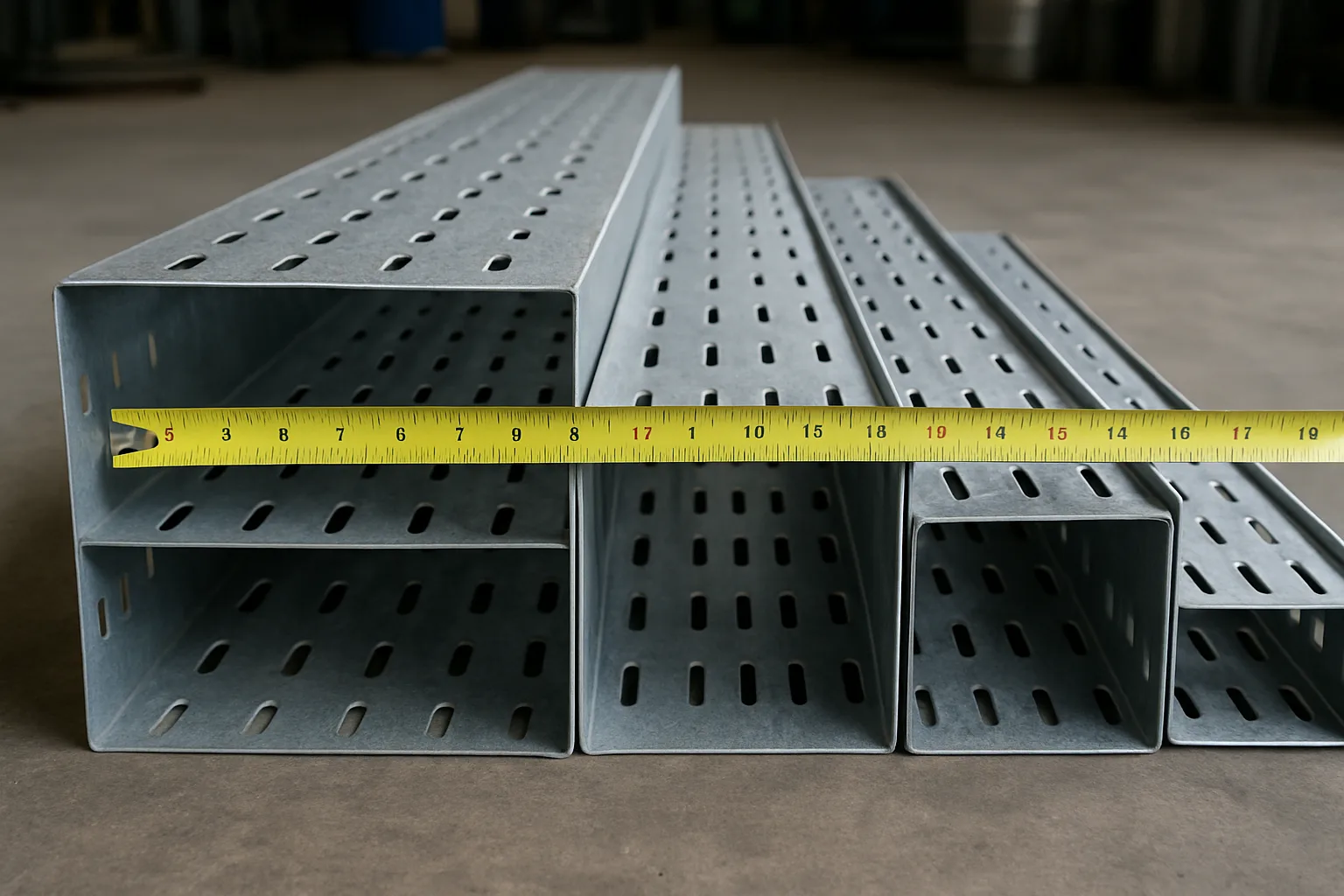
Most industrial and commercial specifications in India move within a fairly narrow set of dimensions. Knowing them helps you write a tender that manufacturers can quote quickly.
Width
Perforated trays are commonly specified in widths from 50 mm for small control and instrumentation runs up to 300 mm, 450 mm, 600 mm and beyond for main power distribution routes. Widths generally step in convenient increments so that bends, tees and reducers match standard fittings. If your calculated requirement lands between two widths, take the larger one. Squeezing cables into a tight tray defeats the purpose of a perforated section.
Height (side rail depth)
Side heights typically run in the 25 mm, 40 mm, 50 mm, 75 mm and 100 mm family. Height does two jobs. It keeps cables inside the tray, and it contributes stiffness to the section. A deeper side rail in the same sheet thickness will sag less over the same span, which is why a 600 mm wide tray is rarely offered with a shallow rail.
Sheet thickness
Perforated trays are usually rolled from sheet in the 1.2 mm to 3 mm band. Light control cable runs on short spans can work in the thinner gauges. Heavy power cables, long spans and outdoor routes where somebody will eventually walk on the tray need the heavier gauges. Thickness is the single specification that buyers most often try to shave to reduce cost, and it is the one that causes the most site problems when it is wrong. Our cable tray thickness guide goes through the gauge choice in more detail.
Length
Standard lengths of 2.5 metres and 3 metres are the norm, because they balance handling on site against the number of joints in a run. Fewer joints means fewer couplers, less labour and a more electrically continuous route. Our full published range of widths, heights, thicknesses and finishes for perforated cable trays sits on the product page if you need to check a particular combination before issuing an enquiry.
How to size width from your cable schedule
This is a straightforward calculation that any project engineer can do in a few minutes.
- List every cable in the run with its outer diameter, including spares and future circuits the client has asked you to allow for.
- Decide on single layer or multi layer. Power cables are best laid in a single layer so that air can reach every core. Control and instrumentation cables are often allowed to bunch.
- Add the diameters for a single layer, or work out the cross sectional area if the cables will be bunched, and apply a fill allowance. Around 40 to 50 percent fill is commonly specified for power runs so that heat can escape and cables can be pulled later.
- Round up to the next standard width and pick a side height that comfortably contains the layer depth.
One warning from site experience. Trays that are sized at exactly 100 percent of today's cables are always the ones that get overloaded within two years. Overfilling is not a cosmetic problem, it raises conductor temperature and derates the cable. We have written separately about the safety hazards of overloading cable trays if you want the detail.
Choosing thickness for span and load
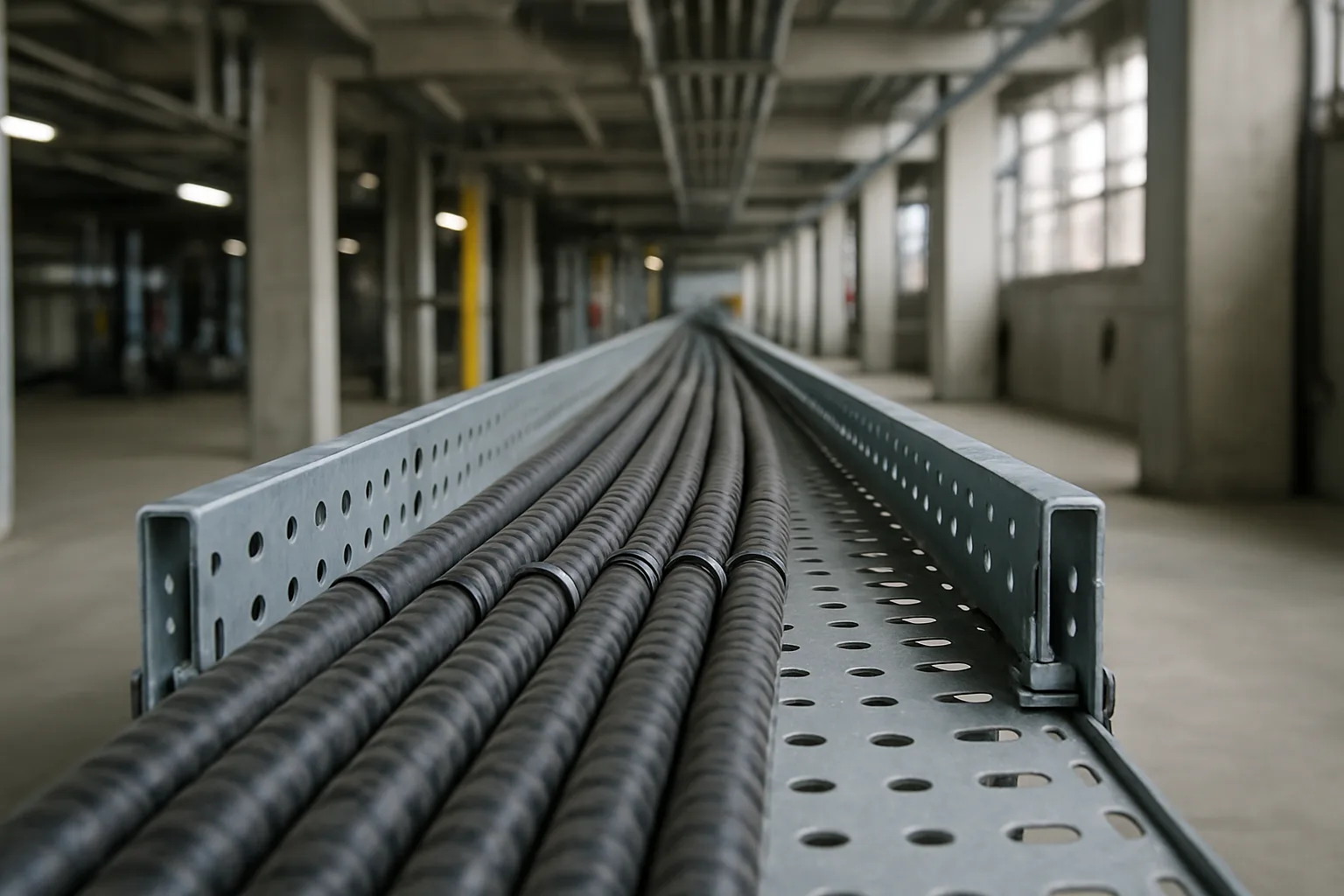
Think of a tray section the way you think of a beam. Cable trays support cable the way that roadway bridges support traffic, and the same two variables decide the answer: how far between supports, and how heavy the load per metre.
- Short spans, light load: instrumentation and telecom runs on supports every 1 to 1.5 metres can use lighter gauge sections in narrower widths.
- Medium spans, mixed load: most factory and commercial power distribution sits here. Wider trays in mid range thickness on supports at regular intervals.
- Long spans, heavy load, outdoor: pipe rack routes, plant yards and solar plant runs carrying multi core armoured cable need the heavier gauges. Wind, dust, monsoon water and the occasional maintenance technician standing on the tray all add load that the cable schedule does not show.
If you cannot increase thickness because of budget, reduce the support spacing instead. The two are interchangeable engineering levers. What is not acceptable is thin sheet on wide spans, which produces visible sag, cracked galvanising at the bend and joints that work loose. Hutaib Electricals have designed cable trays by taking care of cable loads and practical site problems, and our slotting patterns allow easy cutting and joining at any point without drilling at site, so adjusting support positions during installation is not a problem.
Perforation, ventilation and heat dissipation
Width and thickness are only half the story. The reason you chose a perforated cable tray for ventilation and heat dissipation in the first place is the slot pattern in the base. Open area allows convection air movement across the cable surface, which keeps operating temperature down and protects insulation life. Perforations also let dust and water fall through instead of collecting under the cables, and they give fixing points for cable ties along the whole run. When you increase tray width, keep the same proportion of open area, otherwise a wide tray packed with cables behaves like a closed duct.
Finish and standard: getting IS-277 and IS-2629 right
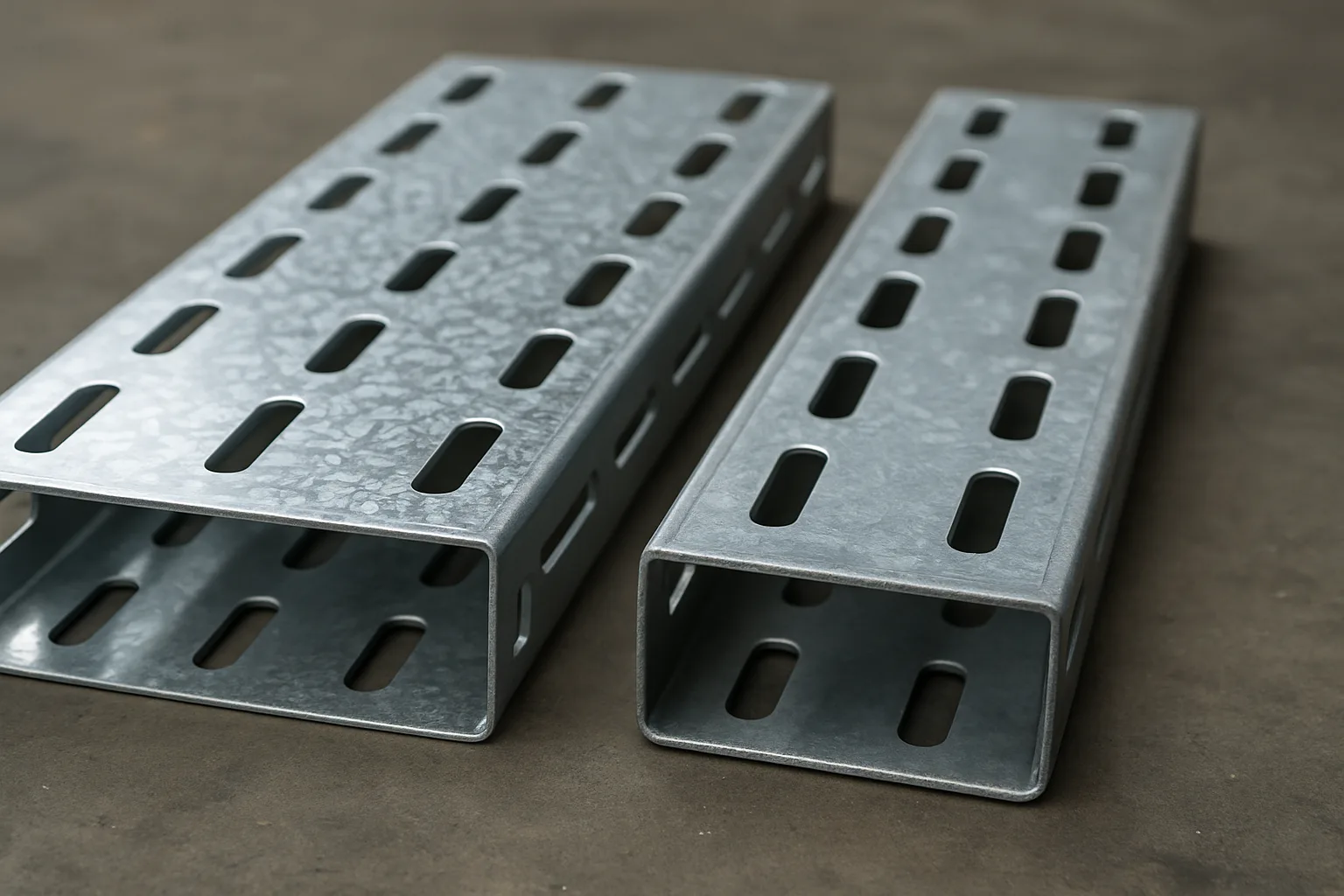
Once size and gauge are settled, the environment decides the finish. Indoor dry areas are usually served by Pre-Galvanised as per IS-277 sheet, which is the specification most buyers mean when they ask about the perforated cable tray IS-277 standard. Outdoor, coastal, chemical and effluent areas call for Hot Dip Galvanised as per IS-2629, where zinc is applied after fabrication and covers cut edges and welds. Where corrosion is severe or hygiene matters, we supply SS 202, 304 and 316. Note that hot dip galvanising after cutting is the reason many specifications also fix a minimum thickness. Very thin sheet distorts in the zinc bath.
Where sizes and thickness show up in price
Buyers comparing quotations often find that a perforated cable tray price gap between two vendors comes down to gauge, side height or coating class rather than the tray itself. Before you compare, make sure both offers state width, height, sheet thickness, length and finish standard. A quotation without those five figures is not comparable. Accessories matter too, since bends, elbows, tees, crosses and reducers must be made in the same width, height and finish as the straight lengths. We manufacture fittings in single piece construction wherever possible, and the full range of cable tray accessories follows the same size and thickness options as the trays.
Working with a Pune based manufacturer on non standard sizes
In the world of cable management, one size does not fit all. Where a layout needs an intermediate width, a deeper rail, a different perforation pattern or a mixed finish across one route, we develop custom made cable trays and accessories through our in house R&D, as per customers' demands. As perforated cable tray suppliers in Pune with our own manufacturing, quality control and packing units, we supply across Pune and Mumbai, the rest of India and export markets, with prompt delivery on standard sections.
Send us your cable schedule, route length and support spacing and our technocrats will come back with a recommended width, height, thickness and finish along with a quotation. You can reach the works through our contact page.
Frequently asked questions
What is the most common perforated cable tray size and thickness for industrial power runs?
There is no single default, but mid range widths with a 50 mm to 75 mm side height in a mid to heavy sheet gauge cover a large share of factory power distribution. The correct figure always comes from your cable schedule and support spacing. Send us both and we will recommend a size and thickness combination.
Does thicker sheet always mean a better cable tray?
Not always. Thicker sheet adds load capacity and stiffness, but it also adds weight and cost, and it is wasted on short spans carrying light control cables. The right approach is to match thickness to span and load per metre, then use support spacing as the second adjustment.
What does IS-277 mean on a perforated cable tray specification?
IS-277 is the Indian standard for galvanised steel sheet, and it is what buyers refer to when they specify pre-galvanised trays. For outdoor and corrosive locations, hot dip galvanising as per IS-2629 is applied after fabrication so that cut edges and welds are also coated. We supply both, along with powder coated, painted and SS 202, 304 and 316 options.
Can you manufacture perforated cable trays in non standard widths and heights?
Yes. We develop custom made cable trays and accessories through our in house R&D as per customers' demands, including intermediate widths, deeper side rails and specific perforation patterns. Matching bends, elbows, tees, crosses and reducers are made in the same size and finish.
How much fill should I allow when sizing tray width?
Around 40 to 50 percent fill is commonly specified for power cable runs so that air can circulate and cables can be added or pulled later. Sizing a tray to exactly today's cable count is the usual cause of overloaded trays within a couple of years. Always include declared spares and future circuits in the calculation.