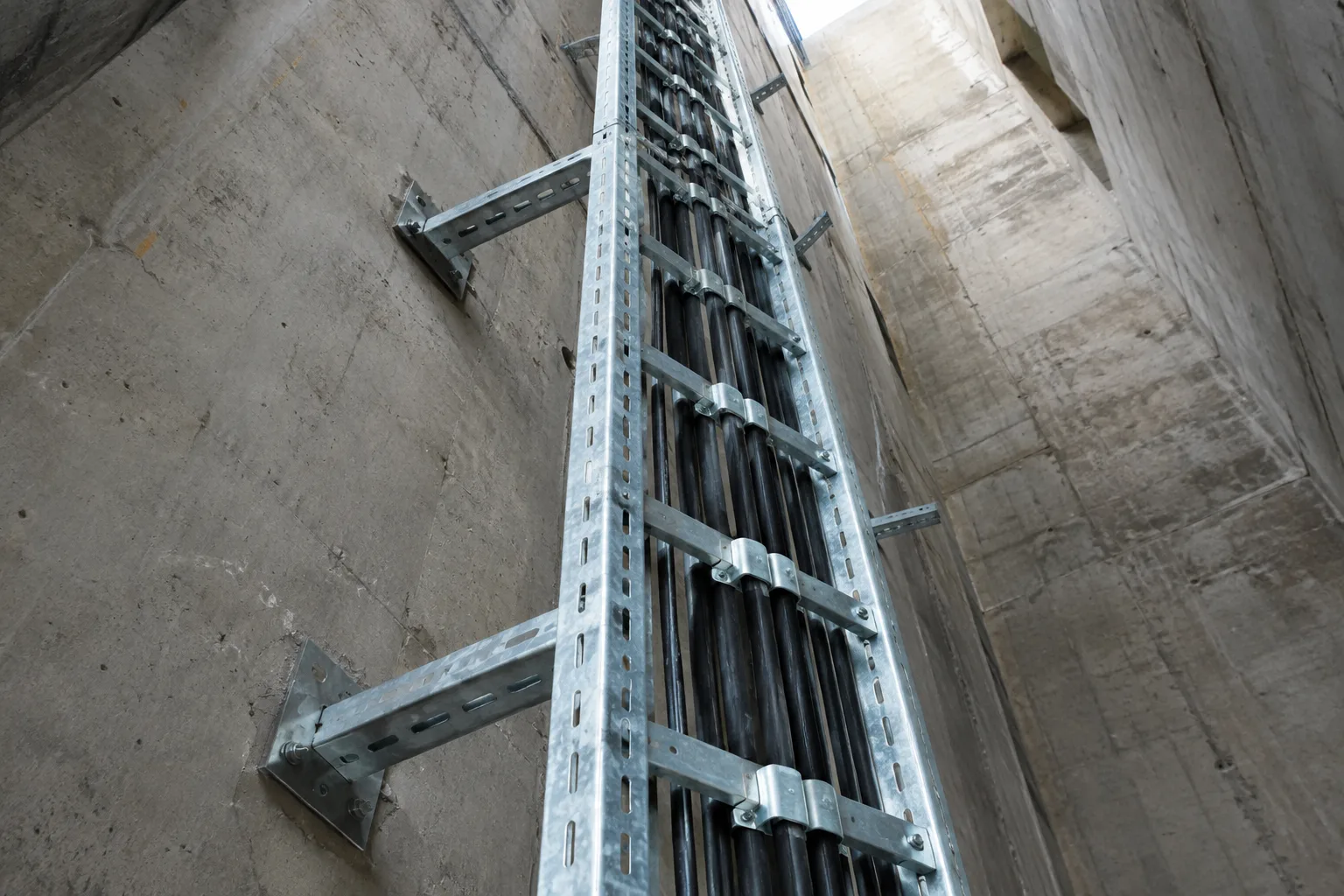
What is the right riser cable tray for high rise buildings?
For most riser shafts, the right riser cable tray for high rise buildings is a ladder type cable tray, fixed vertically to the shaft wall on regularly spaced brackets, with every cable clamped to the rungs so its weight is carried by the tray and not by the cable terminations. The tray must be sized for the full cable load plus spare capacity, finished to suit the shaft environment, and sealed with a fire stopping system wherever it passes through a floor slab. Getting these four decisions right at drawing stage avoids most of the rework seen in residential and commercial towers.
This guide is written for electrical contractors, MEP consultants and EPC teams working on high-rise and redevelopment projects in Mumbai, Thane and Navi Mumbai. It covers tray selection for vertical runs, support arrangement, coordination inside a crowded shaft and fire stopping at slab penetrations.
Why riser shafts in Mumbai towers need a different approach
A riser shaft carries the building's main LT feeders, rising mains, earthing conductors, fire alarm, telecom and building management cables from the basement or podium up to every floor. In Mumbai, two conditions make riser design harder than in a typical low-rise building.
First, redevelopment towers replacing older cooperative housing society buildings and slum rehabilitation projects are often designed on tight plots, so electrical shafts are narrow and shared with plumbing, fire fighting and HVAC services. Second, the coastal climate along the western suburbs, South Mumbai and the creek belts means humid, salt-laden air that reaches shafts through louvres, terrace openings and service floors. Both affect tray width, layout and finish.
As experienced cable tray manufacturers in Mumbai and Pune projects alike will tell you, a vertical run is not just a horizontal tray turned on its side. Cable weight acts along the tray, supports take load in shear and bending, and access for pulling and inspection is limited to a door or opening on each floor.
Vertical ladder runs: tray type, width and cable fixing
Why ladder trays suit risers
Ladder type cable trays give a continuous row of rungs along the run, which is exactly what vertical cabling needs: a fixing point for cable clamps or cleats at regular intervals. The open construction also allows heat from heavily loaded power cables to dissipate, which matters in a closed shaft where air movement is limited. Our ladder cable tray range is published with standard widths, side heights and thicknesses so the consultant can select a section against the actual cable schedule.
Perforated cable trays are still used in risers for lighter control, data and low current cabling, often running alongside the main ladder tray. Where telecom or data cables need a separate, segregated route, a raceway or trunking section can be added on the same support system. For more on that option, see our note on choosing the right raceway cable tray.
Fixing cables on vertical runs
- Clamp at regular intervals. Heavy armoured cables must be cleated or clamped to the rungs along the full height so that no single termination or bend carries the weight of the cable below it.
- Plan the cable layout across the tray. Keep power and control groups in defined positions so cables can be identified and replaced floor by floor.
- Allow spare width. Riser trays are very difficult to widen after handover, so include space for future tenant feeders, EV charging circuits and solar or backup supply cabling.
- Use proper transition fittings. Where the run turns from horizontal at basement or terrace level into the vertical shaft, use vertical inside and outside bends rather than site-cut joints. Our article on cable tray accessories such as bends, tees and covers explains how each fitting is used.
Support spacing and bracket arrangement in the shaft
There is no single support spacing that suits every riser. Spacing depends on the tray width, side height and sheet thickness, the total cable weight per metre and the type of bracket and anchor used. The safe approach is to fix spacing from the manufacturer's load data for the selected section and then check that the anchors in the shaft wall or slab edge can carry the combined load with an adequate margin.
In practice, riser supports are usually built from slotted channels or unistrut sections fixed to the shaft wall, with the ladder tray bolted to the channels. A few points we see repeatedly on Mumbai sites:
- Provide a support close to every slab level so the floor penetration is not carrying tray load.
- Check concrete quality and edge distance before choosing anchors, especially in redevelopment towers where shaft walls may be thin.
- Keep a consistent fixing line from floor to floor so the run stays plumb across the full height.
- Allow for expansion where long vertical runs pass through areas with large temperature differences, such as terrace plant rooms.
Our trays use slotting patterns that allow cutting and joining at any point without drilling at site. In a riser this is useful because floor-to-floor heights and slab thicknesses vary slightly, and the installer can adjust lengths inside the shaft without hot work or swarf.
Shaft coordination with MEP and civil teams
Most riser problems are coordination problems. The tray is often installed after the shaft has been partly occupied by pipes, ducts and fire fighting mains, leaving too little clear space for cable pulling and bending radius. We recommend agreeing the following at design stage:
- Shaft dimensions against tray width. Allow working space in front of the tray for pulling and clamping cables, not just the tray footprint.
- Slab opening sizes and positions. Openings must line up floor to floor and be sized for the tray plus the fire stopping detail.
- Segregation. Separate power, emergency and low current systems with dedicated trays or dividers, as specified by the consultant.
- Earthing continuity. Confirm how tray sections will be bonded along the full height and connected to the building earthing system.
- Access. Provide shaft doors or removable panels on each floor for inspection, maintenance and future cable additions.
When the cable schedule and shaft drawings are shared with us early, we can propose tray widths, fittings and support details that fit the actual shaft, including custom made cable trays where standard sizes do not suit.
Fire stopping at every floor slab
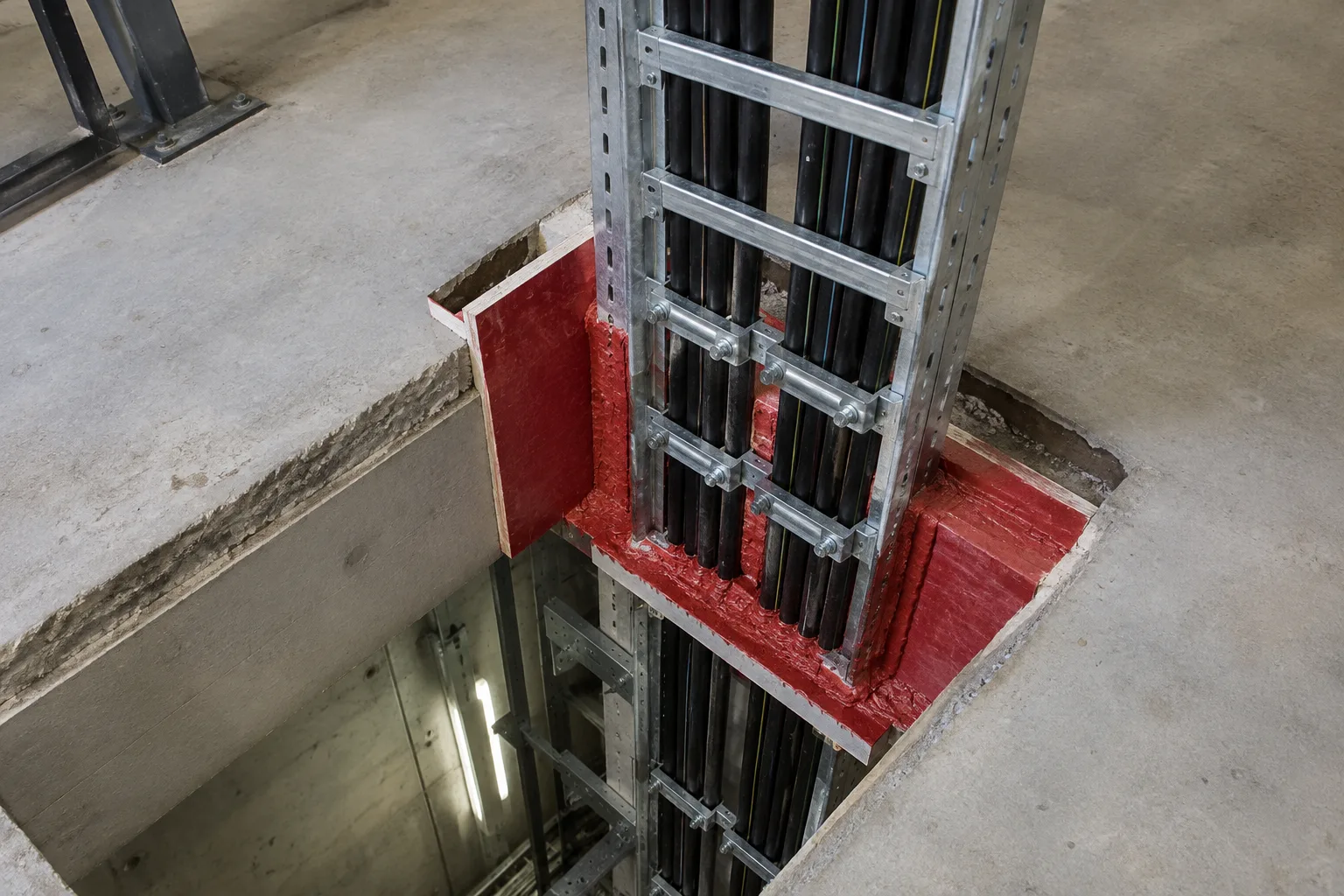
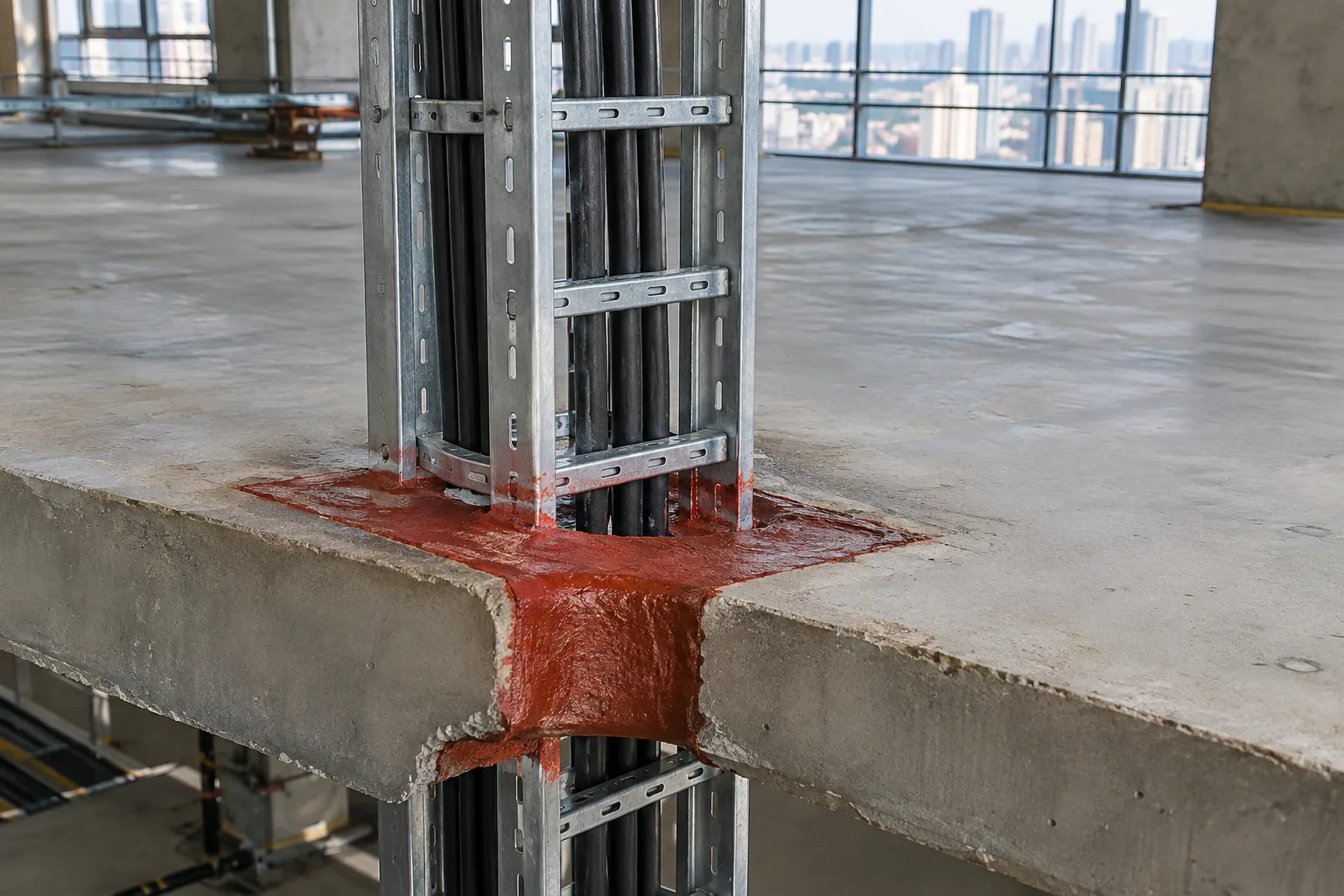
A riser shaft is a vertical path that can carry fire and smoke between floors if penetrations are left open. The National Building Code of India, in Part 4 on Fire and Life Safety, calls for openings in floors through which electrical services pass to be sealed with fire-resistant material so that fire separation between floors is maintained. Project fire consultants and local fire authority requirements set the exact rating and approved system.
For the tray contractor, this means the tray must allow the fire stopping system to be fitted properly: clear space around the tray at the opening, cables spread so sealant or pillows can fill gaps, and no tray joints positioned inside the slab. Plan for re-sealing after future cable additions as well. For broader guidance, read our cable tray fire safety tips for commercial buildings.
Material, thickness and finish for Mumbai risers
Hutaib Electricals' working principle is simple: "Selecting the right cable tray depends on cable load, installation environment, support spacing, material and required finish." For risers, that usually leads to one of three choices:
- Pre-galvanised steel to IS-277 for dry, enclosed internal shafts in commercial and residential towers.
- Hot dip galvanised steel to IS-2629 where shafts are humid, open to terrace or service floors, or close to the sea, as is common across coastal Mumbai.
- Stainless steel (SS 304 or SS 316) for highly corrosive locations or where the client specifies it, such as hospitals, pharma or coastal plant rooms.
Thickness should be selected against load and support spacing rather than price alone. A thinner tray on closer supports can work, but it increases anchor count and installation time in a shaft where every fixing is difficult to reach.
Ordering riser trays for a Mumbai project
Hutaib Electricals has manufactured cable trays and accessories since 2001, with in-house manufacturing, quality control and packing units under one roof in Pune. Fittings are made in single-piece construction wherever possible, which reduces joints along vertical transitions. As a manufacturer, supplier and exporter, we supply electrical cable tray systems across India and overseas; you can see our wider cable tray manufacturing and supply range, and our cable tray supply for Mumbai projects covers towers, commercial buildings and industrial cable trays in Mumbai, Thane and Navi Mumbai.
For riser tray packages, share your shaft drawings, cable schedule, number of floors and required finish with our team, and request a quotation for your project. We will propose tray sizes, fittings and supports matched to your project-specific requirements.
Frequently asked questions
Should I use ladder or perforated cable tray in a riser shaft?
Ladder type cable tray is generally preferred for main power cables in a riser because the rungs give regular fixing points for cable clamps and the open design helps heat dissipation. Perforated trays are often used alongside for lighter control, data and low current cables. Many towers use both on a common support system.
What support spacing should be used for a vertical riser cable tray?
Support spacing depends on tray width, side height, thickness, total cable weight and the anchors used, so there is no single figure for every project. Spacing should be taken from the manufacturer's load data for the chosen section and checked against anchor capacity in the shaft wall. A support near each slab level is good practice.
Which finish is best for riser cable trays in Mumbai?
Pre-galvanised steel to IS-277 suits dry, enclosed internal shafts. Hot dip galvanised steel to IS-2629 is better for humid shafts, shafts open to terraces or buildings close to the sea. Stainless steel is used where corrosion is severe or the client specifies it.
Can you make custom riser trays to match our shaft drawings?
Yes. Hutaib Electricals makes custom made cable trays and accessories through in-house R&D and manufacturing in Pune. Share your shaft drawings, cable schedule and quantities and we will propose suitable sizes and fittings.
Do you supply riser cable trays to sites in Mumbai, Thane and Navi Mumbai?
Yes. We are a Pune-based manufacturer, supplier and exporter serving Mumbai, Thane, Navi Mumbai, the rest of India and export markets. Bulk cable tray requirements for tower projects can be quoted against your drawings and delivery schedule.