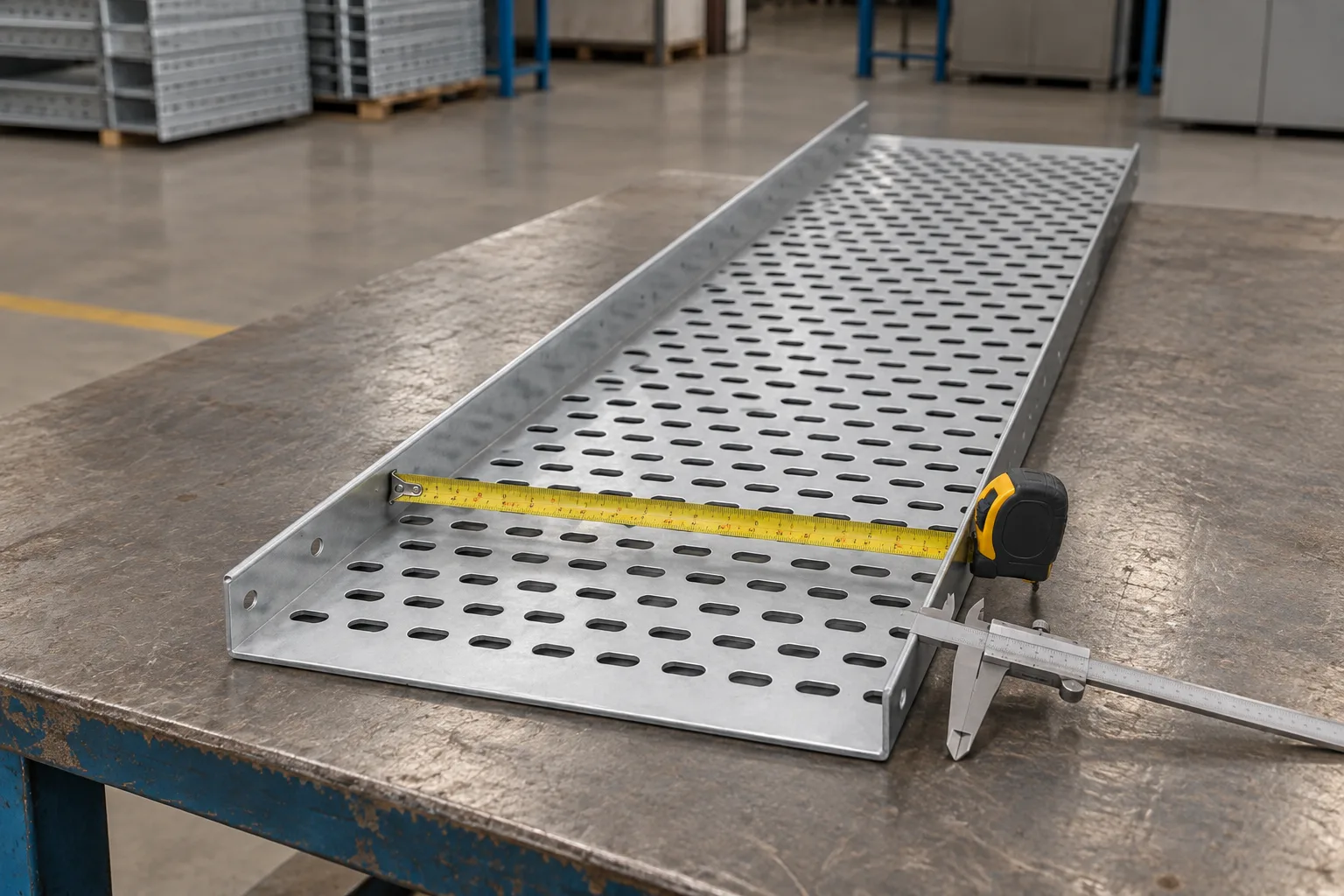
Cable tray standard sizes in mm in India commonly run from 50 mm to 900 mm in width (ladder trays go wider), 25 mm to 150 mm in height, and are supplied in straight lengths of 2,500 mm or 3,000 mm. Sheet thickness usually falls between 1.0 mm and 3.0 mm, depending on tray type and the load it must carry. The correct size for a project comes from the cable schedule, support spacing and site environment, not from width alone.
This post is a single reference chart covering ladder, wire mesh basket, raceway and solid bottom trays. If you are working only with perforated trays, our earlier guide on perforated cable tray sizes and thickness goes deeper into choosing width, height and sheet gauge for a cable schedule.
How Cable Tray Sizes Are Described
Every electrical cable tray system is specified by four dimensions. Getting all four on the drawing or purchase order avoids most site problems.
- Width (W): the usable inside width where cables are laid. This is the main figure for cable fill.
- Height or depth (H): the height of the side flange or side rail. It decides how many layers of cable the tray can hold and how well cables stay in place.
- Length (L): the length of one straight section. Shorter lengths are easier to handle in ceilings and shafts; longer lengths mean fewer joints on long runs.
- Thickness (T): the sheet or rail thickness in mm. Together with height, this governs the load the tray can carry between supports.
Widths tend to step in round increments worldwide. NEMA VE 1, the North American cable tray standard, lists widths such as 6, 12, 18, 24, 30 and 36 inches, which correspond roughly to 150, 300, 450, 600, 750 and 900 mm. Indian projects usually work directly in millimetres with similar steps, plus smaller widths of 50 and 100 mm for control and instrumentation cabling.
Cable Tray Standard Sizes in mm: Reference Chart by Type

The ranges below reflect common industry practice for steel trays in India. Exact published sizes vary by manufacturer, so always confirm against the supplier's technical specifications before finalising a bill of quantities.
Perforated Cable Trays
- Width: 50 mm to 900 mm
- Height: 25 mm to 100 mm
- Thickness: 1.2 mm to 2.5 mm
- Length: 2,500 mm standard
Perforated cable trays are the general-purpose choice for organised cable routing in industrial plants, commercial buildings and electrical infrastructure. The perforations allow ventilation, drainage and easy fixing of cable ties and clamps.
Ladder Type Cable Trays
- Width: 150 mm to 1,000 mm, with wider sizes made to order
- Side rail height: 50 mm to 150 mm
- Thickness: 1.6 mm to 3.0 mm
- Rung spacing: commonly 250 mm to 300 mm
- Length: 2,500 mm or 3,000 mm
Ladder type cable trays are used for heavy power cables, long spans and outdoor runs where maximum ventilation and strength are needed. Taller side rails and thicker sections allow wider support spacing.
Wire Mesh Basket Cable Trays
- Width: 50 mm to 600 mm
- Height: 30 mm to 100 mm
- Wire diameter: 4 mm to 6 mm
- Mesh: commonly 50 mm x 100 mm
- Length: 3,000 mm standard
Wire mesh basket cable trays suit data centres, false ceilings and commercial buildings carrying data, low voltage and light power cables. They are light, quick to cut and bend on site, and keep cables visible for future changes. See our range of basket cable trays in India for available configurations.
Raceways and Trunking Systems
- Width: 50 mm to 600 mm
- Height: 25 mm to 150 mm
- Thickness: 1.0 mm to 2.0 mm
- Length: 2,500 mm, supplied with matching covers
Raceways are fully enclosed and are chosen where cables need protection from dust, mechanical damage or tampering, or where a neat finished look is required. Our page on metal cable trunking and raceways covers the product range, and the guide to electrical raceway sizes, depth and GI thickness explains cable fill in detail.
Solid Bottom Cable Trays
- Width: 50 mm to 900 mm
- Height: 25 mm to 100 mm
- Thickness: 1.2 mm to 2.5 mm
- Length: 2,500 mm, with optional covers
Solid bottom trays give continuous support and better shielding for sensitive signal and instrumentation cables. They hold more heat than ventilated trays, so cable derating needs attention. For a side-by-side view of how these types behave, read our article comparing different types of cable trays.
Thickness, Load and Support Spacing
Thickness should never be selected from width alone. A 600 mm tray carrying armoured power cables needs a very different section from a 600 mm tray carrying data cables. The questions that decide thickness are:
- Total cable weight per metre, including a margin for future cables
- Distance between supports (span)
- Point loads such as fittings, junction boxes or maintenance access
- Environmental loads on outdoor runs, such as wind or water accumulation
IEC 61537, the international standard for cable tray and cable ladder systems, defines how safe working load is tested at a declared support span. This is why load figures are only meaningful when quoted with the span they apply to. At Hutaib Electricals, trays are designed around actual cable loads and practical site conditions, and thickness is matched to the support spacing on your layout.
Pre-Galvanised vs Hot Dip Galvanised Cable Tray and Other Finishes
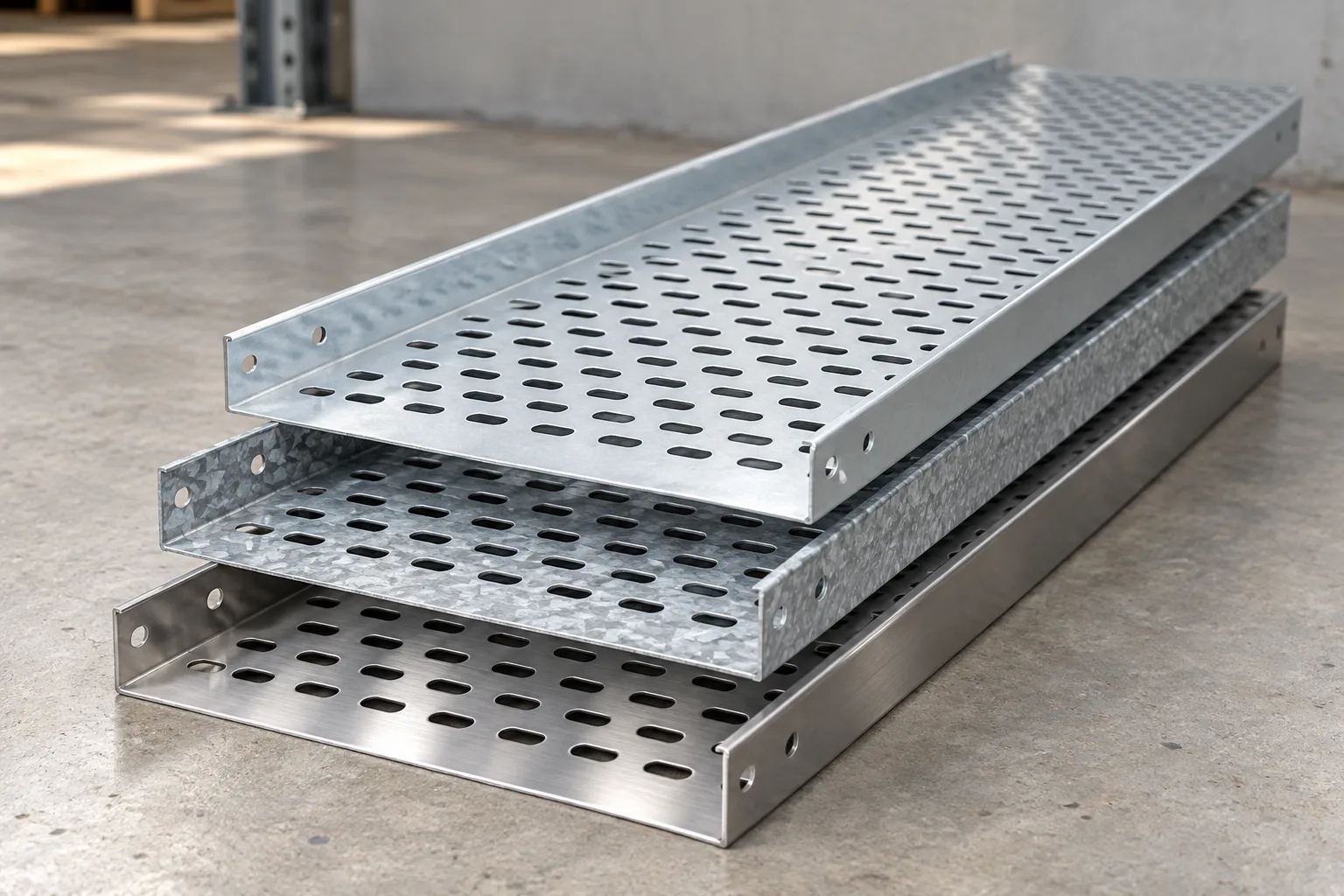
The same size can be supplied in different finishes, and the finish often matters as much as thickness for service life.
- Pre-galvanised (IS 277): IS 277 covers galvanised steel sheet and strip. The tray is formed from sheet that is already zinc coated, so cut and punched edges are protected only by the surrounding zinc. It is well suited to indoor, dry installations.
- Hot dip galvanised (IS 2629): IS 2629 is the Indian recommended practice for hot dip galvanising of fabricated iron and steel. The finished tray is dipped after fabrication, so edges, holes and welds are all coated. It is preferred for outdoor, industrial and humid sites.
- Stainless steel (SS 202, 304, 316): used in food, pharma, coastal and chemical environments. SS 316 is generally chosen for the most aggressive conditions.
- Powder coated or painted: for visible installations or colour coding of services.
How to Choose the Right Size for Your Cable Schedule
- Add up the total cross-sectional area or diameter of all cables on the route.
- Apply your fill allowance and keep spare space for future expansion.
- Choose a height that comfortably exceeds the largest cable diameter and the number of layers planned.
- Confirm the load at your support span and select thickness accordingly.
- Select material, thickness and finish for the installation environment.
- Match all bends, tees, crosses and reducers to the same width and height so the route is continuous.
Hutaib trays use slotting patterns that allow cutting and joining at any point without drilling at site, and fittings are made in single-piece construction wherever possible, which keeps installation time down on long routes.
Custom Made Cable Trays and Bulk Requirements
Established in 2001, Hutaib Electricals is a cable tray manufacturer in India with in-house manufacturing, quality control and packing units in Pune. Where standard sizes do not fit a layout, our in-house R&D develops custom made cable trays and accessories to project-specific requirements. We supply Pune, Mumbai, the rest of India and export markets including the UAE, Nepal, Bangladesh and Bhutan.
As our engineering team puts it, "Selecting the right cable tray depends on cable load, installation environment, support spacing, material and required finish." For bulk cable tray requirements or non-standard dimensions, share your drawings, cable schedule and quantities and request a quotation from our team.
Frequently asked questions
What is the standard length of a cable tray in India?
Most steel cable trays in India are supplied in straight lengths of 2,500 mm, with ladder and wire mesh basket trays also commonly available in 3,000 mm. Custom lengths can be manufactured to suit a specific layout or transport requirement.
Which cable tray thickness should I choose?
Thickness depends on the cable weight per metre and the distance between supports, not on width alone. Light data and control runs may use thinner sections, while heavy power cables over long spans need thicker trays or ladder type trays with taller side rails. Share your cable schedule and support spacing with the manufacturer to confirm.
What is the difference between IS 277 and IS 2629 finishes?
IS 277 covers pre-galvanised steel sheet, so the tray is made from sheet that is already zinc coated and is best for indoor use. IS 2629 is the recommended practice for hot dip galvanising after fabrication, which coats cut edges, holes and welds, making it more suitable for outdoor and industrial sites.
Can you make cable trays in non-standard sizes?
Yes. Hutaib Electricals develops custom made cable trays and accessories through in-house R&D, based on project-specific dimensions. Send your drawings, required widths, heights, thickness, finish and quantities for a quotation.
Do the fittings need to match the tray size exactly?
Yes. Bends, tees, crosses and reducers must match the width and height of the straight tray to keep the route continuous and the cables properly supported. Specify fittings along with the straight sections when you order.